
VisionLaw: Inferring Interpretable Intrinsic Dynamics from Visual Observations via Bilevel Optimization
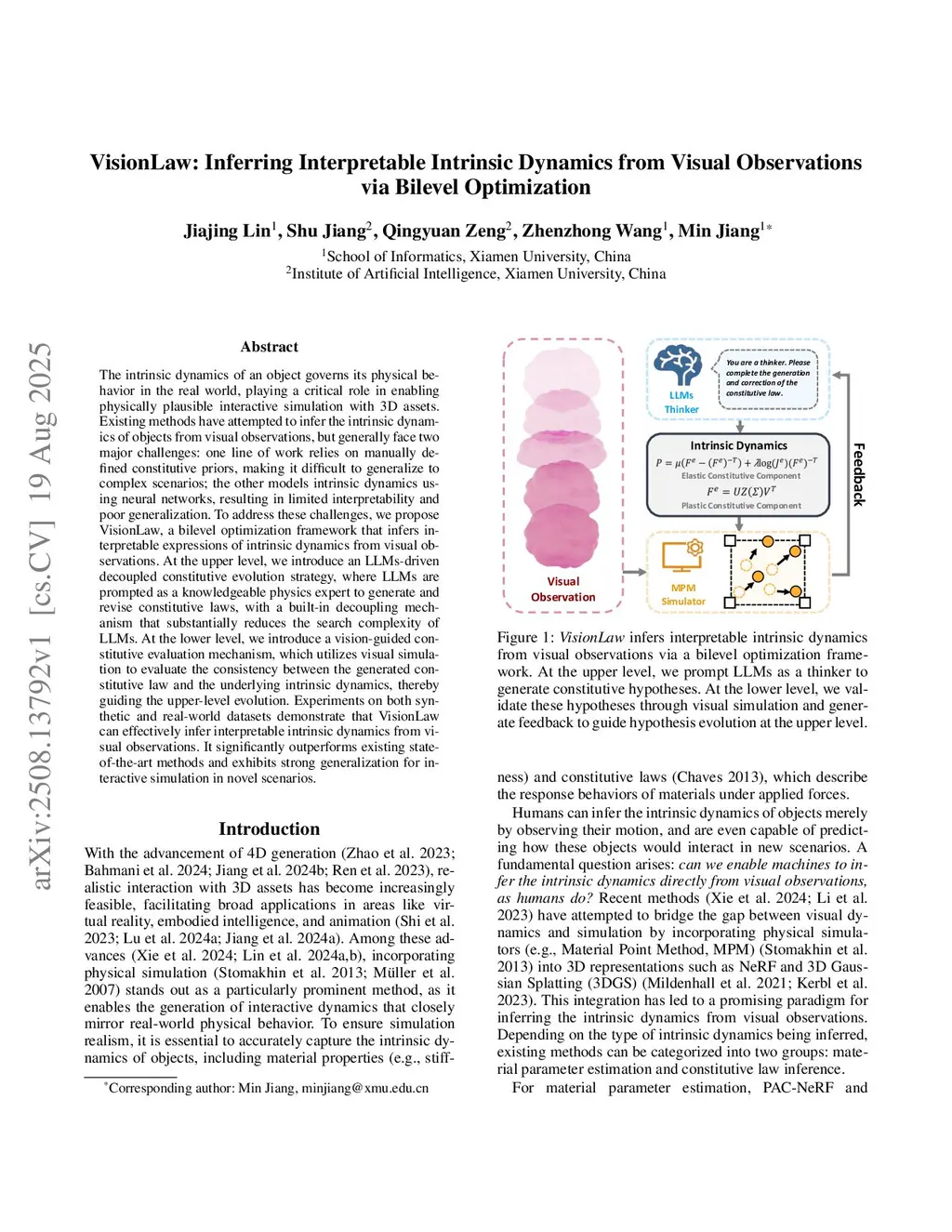
The intrinsic dynamics of an object governs its physical behavior in the real world, playing a critical role in enabling physically plausible interactive simulation with 3D assets. Existing methods have attempted to infer the intrinsic dynamics of objects from visual observations, but generally face two major challenges: one line of work relies on manually defined constitutive priors, making it difficult to generalize to complex scenarios; the other models intrinsic dynamics using neural networks, resulting in limited interpretability and poor generalization. To address these challenges, we propose VisionLaw, a bilevel optimization framework that infers interpretable expressions of intrinsic dynamics from visual observations. At the upper level, we introduce an LLMs-driven decoupled constitutive evolution strategy, where LLMs are prompted as a knowledgeable physics expert to generate and revise constitutive laws, with a built-in decoupling mechanism that substantially reduces the search complexity of LLMs. At the lower level, we introduce a vision-guided constitutive evaluation mechanism, which utilizes visual simulation to evaluate the consistency between the generated constitutive law and the underlying intrinsic dynamics, thereby guiding the upper-level evolution. Experiments on both synthetic and real-world datasets demonstrate that VisionLaw can effectively infer interpretable intrinsic dynamics from visual observations. It significantly outperforms existing state-of-the-art methods and exhibits strong generalization for interactive simulation in novel scenarios.
View on arXiv