
SimGenHOI: Physically Realistic Whole-Body Humanoid-Object Interaction via Generative Modeling and Reinforcement Learning
- VGen
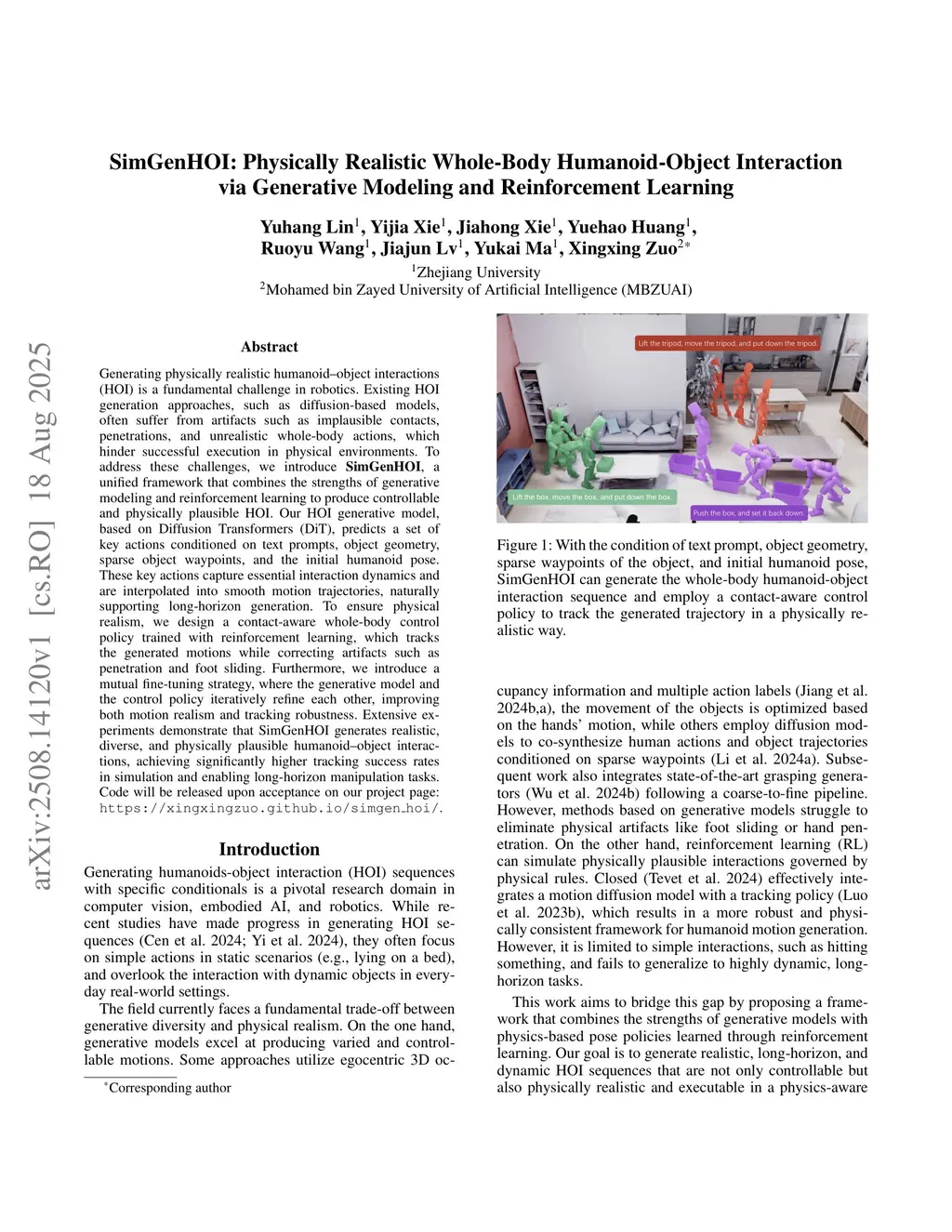
Generating physically realistic humanoid-object interactions (HOI) is a fundamental challenge in robotics. Existing HOI generation approaches, such as diffusion-based models, often suffer from artifacts such as implausible contacts, penetrations, and unrealistic whole-body actions, which hinder successful execution in physical environments. To address these challenges, we introduce SimGenHOI, a unified framework that combines the strengths of generative modeling and reinforcement learning to produce controllable and physically plausible HOI. Our HOI generative model, based on Diffusion Transformers (DiT), predicts a set of key actions conditioned on text prompts, object geometry, sparse object waypoints, and the initial humanoid pose. These key actions capture essential interaction dynamics and are interpolated into smooth motion trajectories, naturally supporting long-horizon generation. To ensure physical realism, we design a contact-aware whole-body control policy trained with reinforcement learning, which tracks the generated motions while correcting artifacts such as penetration and foot sliding. Furthermore, we introduce a mutual fine-tuning strategy, where the generative model and the control policy iteratively refine each other, improving both motion realism and tracking robustness. Extensive experiments demonstrate that SimGenHOI generates realistic, diverse, and physically plausible humanoid-object interactions, achieving significantly higher tracking success rates in simulation and enabling long-horizon manipulation tasks. Code will be released upon acceptance on our project page:this https URL.
View on arXiv