
via Tree Height Compression
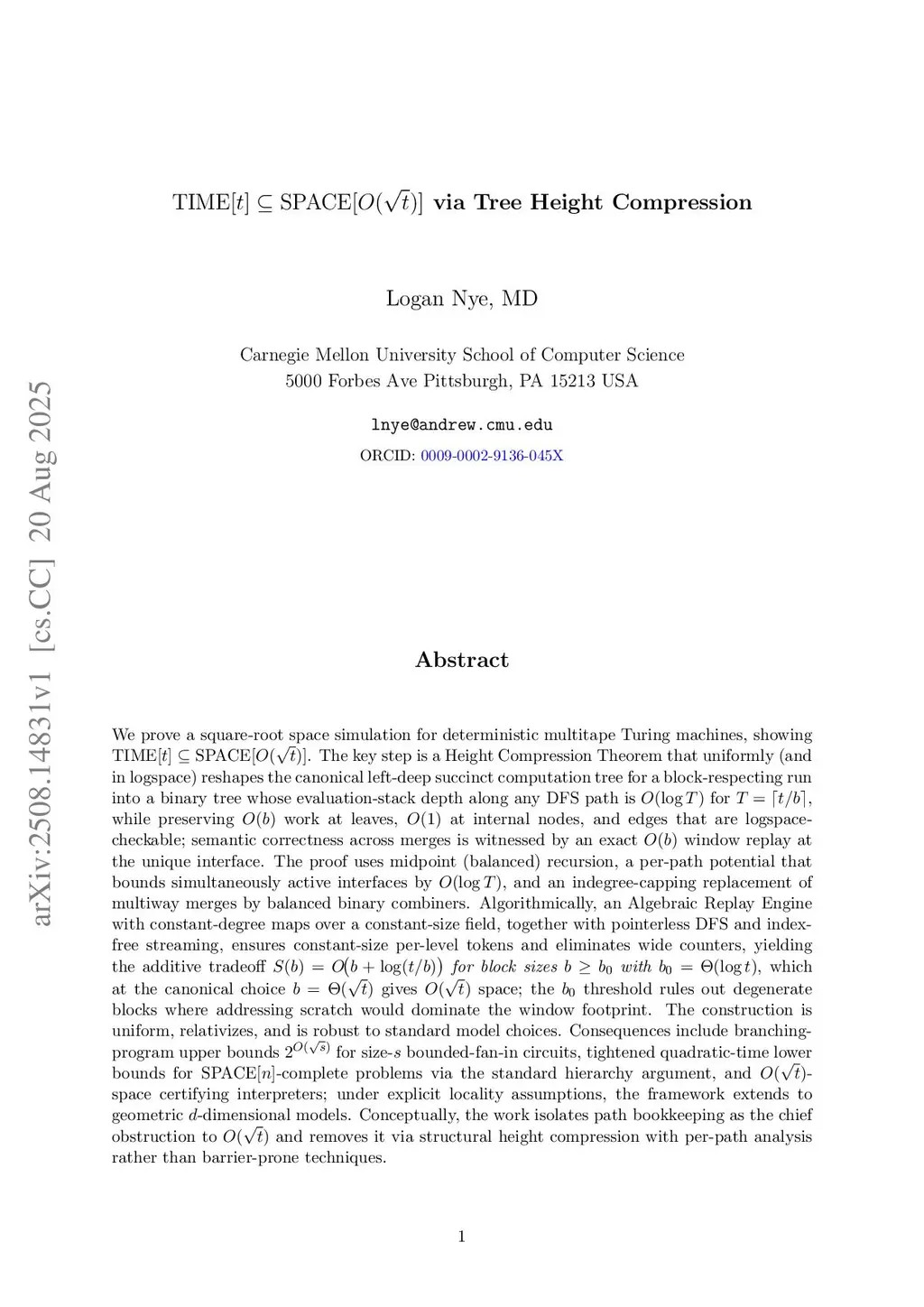
We prove a square-root space simulation for deterministic multitape Turing machines, showing \emph{measured in tape cells over a fixed finite alphabet}. The key step is a Height Compression Theorem that uniformly (and in logspace) reshapes the canonical left-deep succinct computation tree for a block-respecting run into a binary tree whose evaluation-stack depth along any DFS path is for , while preserving workspace at leaves and at internal nodes. Edges have \emph{addressing/topology} checkable in space, and \emph{semantic} correctness across merges is witnessed by an exact bounded-window replay at the unique interface. Algorithmically, an Algebraic Replay Engine with constant-degree maps over a constant-size field, together with pointerless DFS, index-free streaming, and a \emph{rolling boundary buffer that prevents accumulation of leaf summaries}, ensures constant-size per-level tokens and eliminates wide counters, yielding the additive tradeoff . Choosing gives space with no residual multiplicative polylog factors. The construction is uniform, relativizes, and is robust to standard model choices. Consequences include branching-program upper bounds for size- bounded-fan-in circuits, tightened quadratic-time lower bounds for -complete problems via the standard hierarchy argument, and -space certifying interpreters; under explicit locality assumptions, the framework extends to geometric -dimensional models. Conceptually, the work isolates path bookkeeping as the chief obstruction to and removes it via structural height compression with per-path analysis rather than barrier-prone techniques.
View on arXiv