
OVITA: Open-Vocabulary Interpretable Trajectory Adaptations
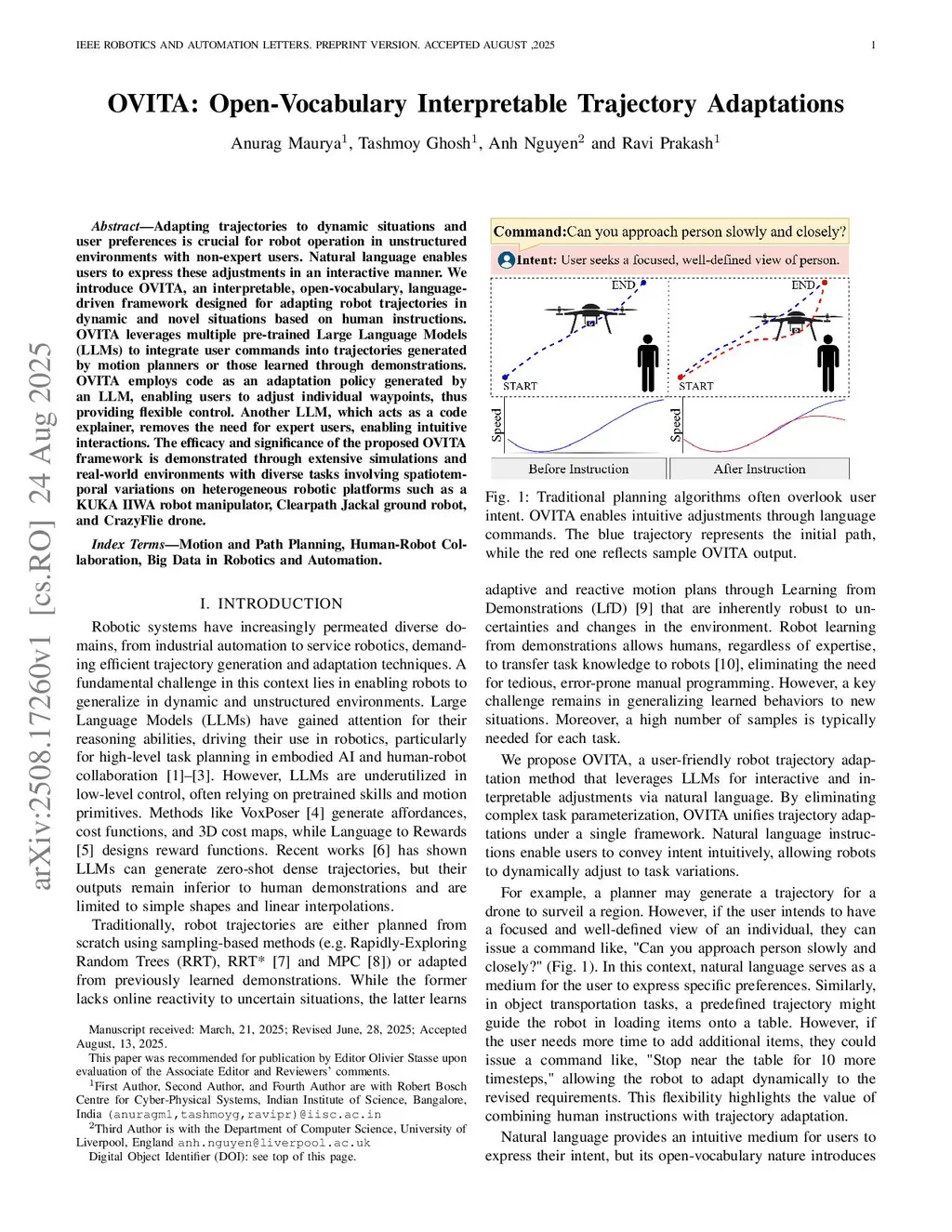
Adapting trajectories to dynamic situations and user preferences is crucial for robot operation in unstructured environments with non-expert users. Natural language enables users to express these adjustments in an interactive manner. We introduce OVITA, an interpretable, open-vocabulary, language-driven framework designed for adapting robot trajectories in dynamic and novel situations based on human instructions. OVITA leverages multiple pre-trained Large Language Models (LLMs) to integrate user commands into trajectories generated by motion planners or those learned through demonstrations. OVITA employs code as an adaptation policy generated by an LLM, enabling users to adjust individual waypoints, thus providing flexible control. Another LLM, which acts as a code explainer, removes the need for expert users, enabling intuitive interactions. The efficacy and significance of the proposed OVITA framework is demonstrated through extensive simulations and real-world environments with diverse tasks involving spatiotemporal variations on heterogeneous robotic platforms such as a KUKA IIWA robot manipulator, Clearpath Jackal ground robot, and CrazyFlie drone.
View on arXiv