
The Evolution of Thought: Tracking LLM Overthinking via Reasoning Dynamics Analysis
- LLMAGLRM
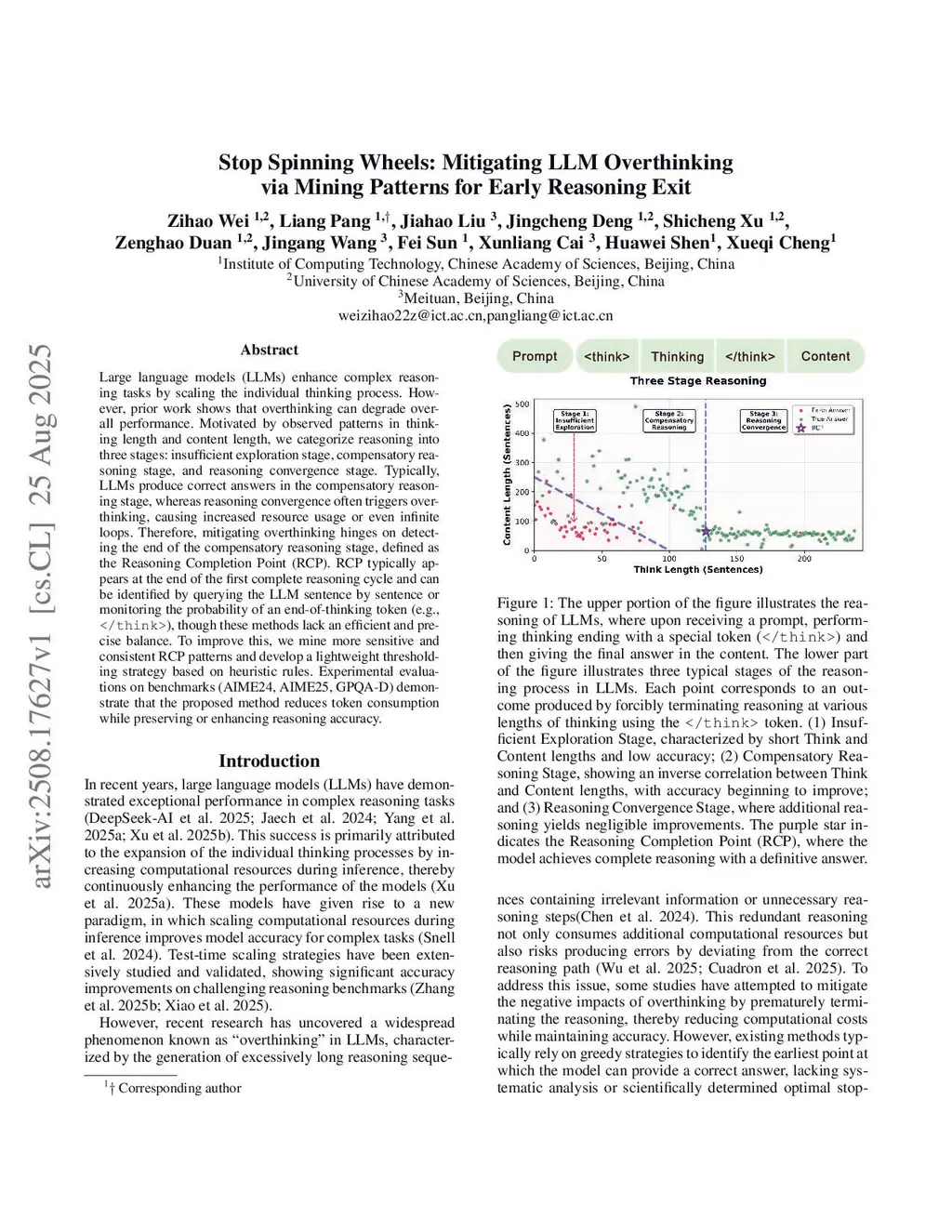
Test-time scaling via explicit reasoning trajectories significantly boosts large language model (LLM) performance but often triggers overthinking. To explore this, we analyze reasoning through two lenses: Reasoning Length Dynamics, which reveals a compensatory trade-off between thinking and answer content length that eventually leads to thinking redundancy, and Reasoning Semantic Dynamics, which identifies semantic convergence and repetitive oscillations. These dynamics uncover an instance-specific Reasoning Completion Point (RCP), beyond which computation continues without further performance gain. Since the RCP varies across instances, we propose a Reasoning Completion Point Detector (RCPD), an inference-time early-exit method that identifies the RCP by monitoring the rank dynamics of termination tokens (e.g., </think>). Across AIME and GPQA benchmarks using Qwen3 and DeepSeek-R1, RCPD reduces token usage by up to 44% while preserving accuracy, offering a principled approach to efficient test-time scaling.
View on arXiv