
FakeParts: a New Family of AI-Generated DeepFakes
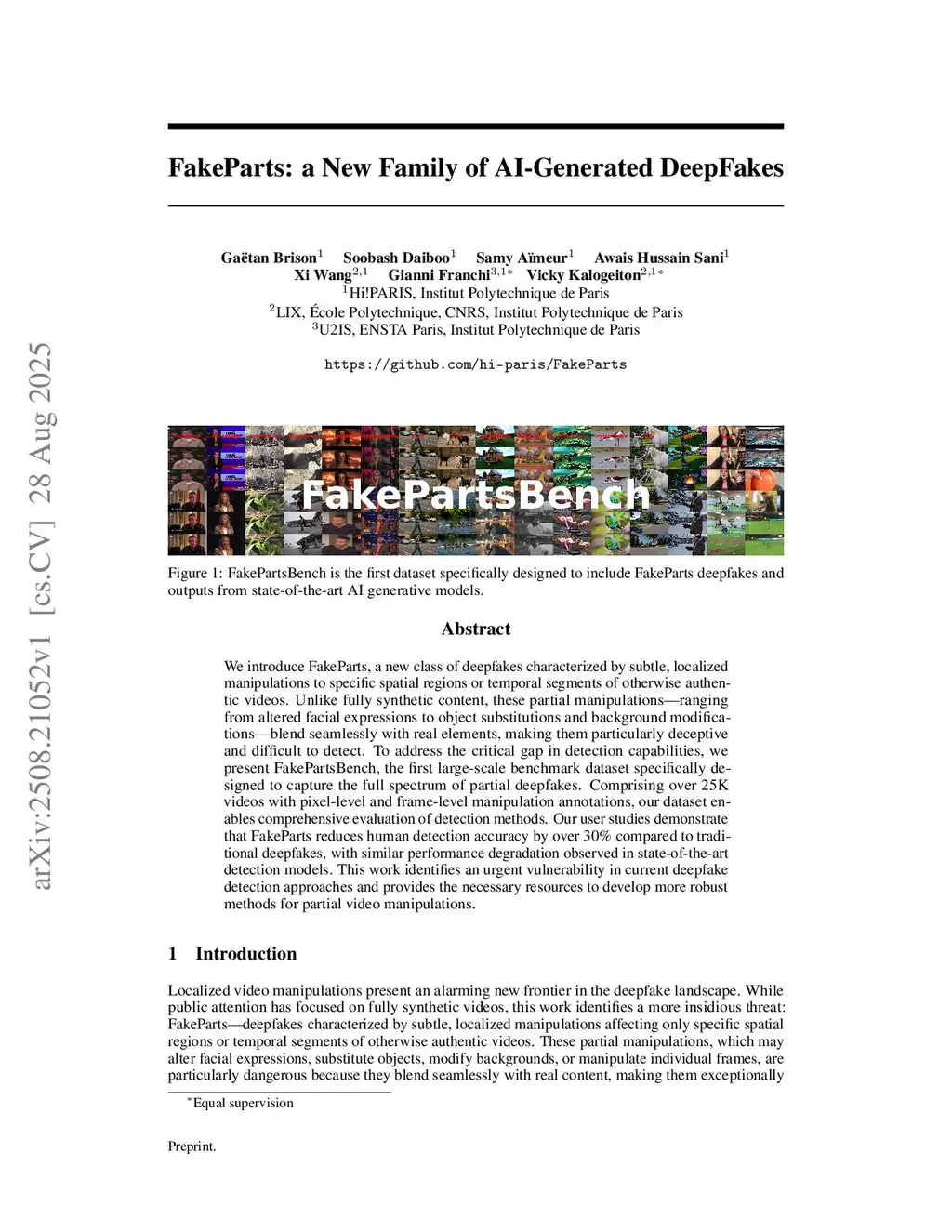
We introduce FakeParts, a new class of deepfakes characterized by subtle, localized manipulations to specific spatial regions or temporal segments of otherwise authentic videos. Unlike fully synthetic content, these partial manipulations - ranging from altered facial expressions to object substitutions and background modifications - blend seamlessly with real elements, making them particularly deceptive and difficult to detect. To address the critical gap in detection, we present FakePartsBench, the first large-scale benchmark specifically designed to capture the full spectrum of partial deepfakes. Comprising over 81K (including 44K FakeParts) videos with pixel- and frame-level manipulation annotations, our dataset enables comprehensive evaluation of detection methods. Our user studies demonstrate that FakeParts reduces human detection accuracy by up to 26% compared to traditional deepfakes, with similar performance degradation observed in state-of-the-art detection models. This work identifies an urgent vulnerability in current detectors and provides the necessary resources to develop methods robust to partial manipulations.
View on arXiv