
Data-Driven Loss Functions for Inference-Time Optimization in Text-to-Image
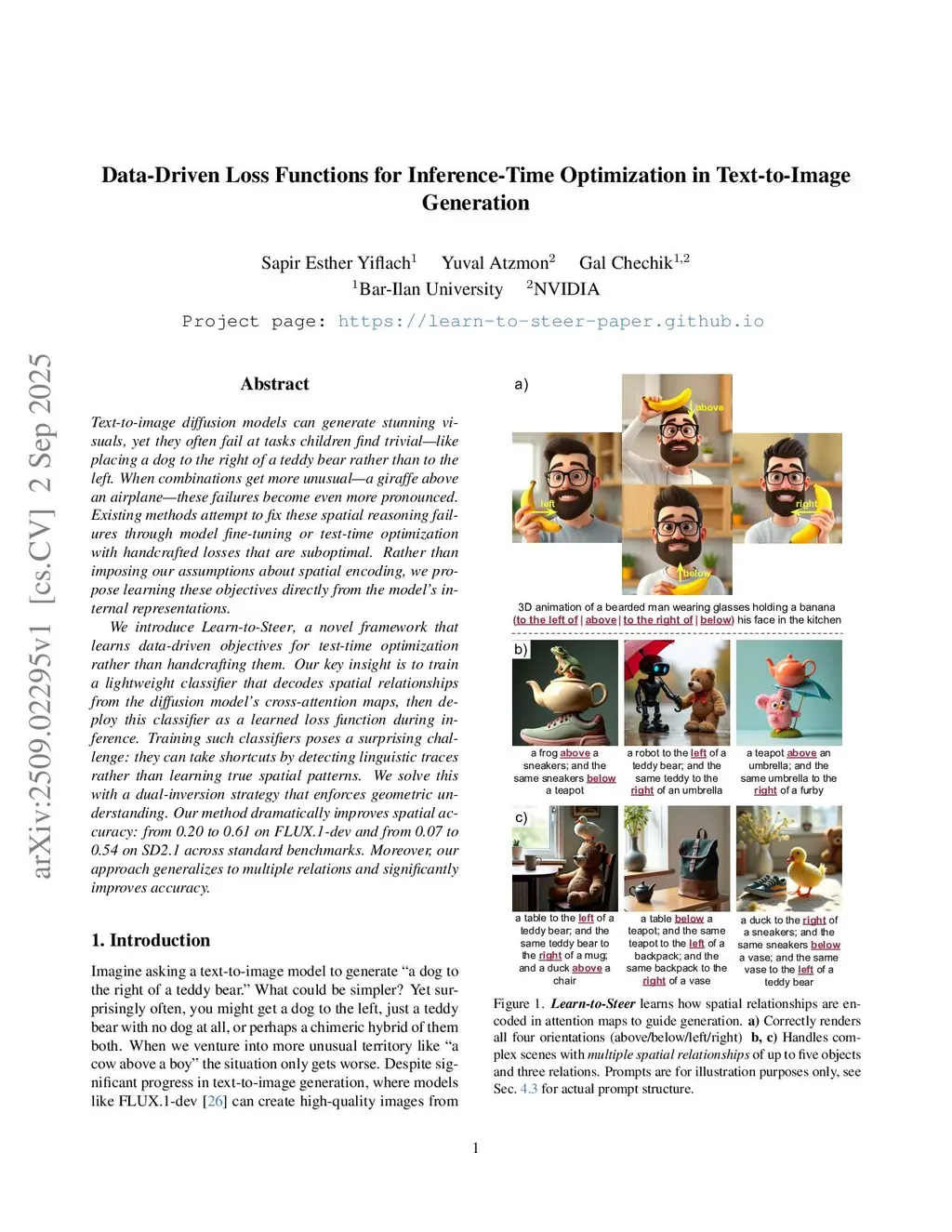
Text-to-image diffusion models can generate stunning visuals, yet they often fail at tasks children find trivial--like placing a dog to the right of a teddy bear rather than to the left. When combinations get more unusual--a giraffe above an airplane--these failures become even more pronounced. Existing methods attempt to fix these spatial reasoning failures through model fine-tuning or test-time optimization with handcrafted losses that are suboptimal. Rather than imposing our assumptions about spatial encoding, we propose learning these objectives directly from the model's internal representations.We introduce Learn-to-Steer, a novel framework that learns data-driven objectives for test-time optimization rather than handcrafting them. Our key insight is to train a lightweight classifier that decodes spatial relationships from the diffusion model's cross-attention maps, then deploy this classifier as a learned loss function during inference. Training such classifiers poses a surprising challenge: they can take shortcuts by detecting linguistic traces in the cross-attention maps, rather than learning true spatial patterns. We solve this by augmenting our training data with samples generated using prompts with incorrect relation words, which encourages the classifier to avoid linguistic shortcuts and learn spatial patterns from the attention maps. Our method dramatically improves spatial accuracy: from 20% to 61% on FLUX.1-dev and from 7% to 54% on SD2.1 across standard benchmarks. It also generalizes to multiple relations with significantly improved accuracy.
View on arXiv