
Neural Breadcrumbs: Membership Inference Attacks on LLMs Through Hidden State and Attention Pattern Analysis
- MIALM
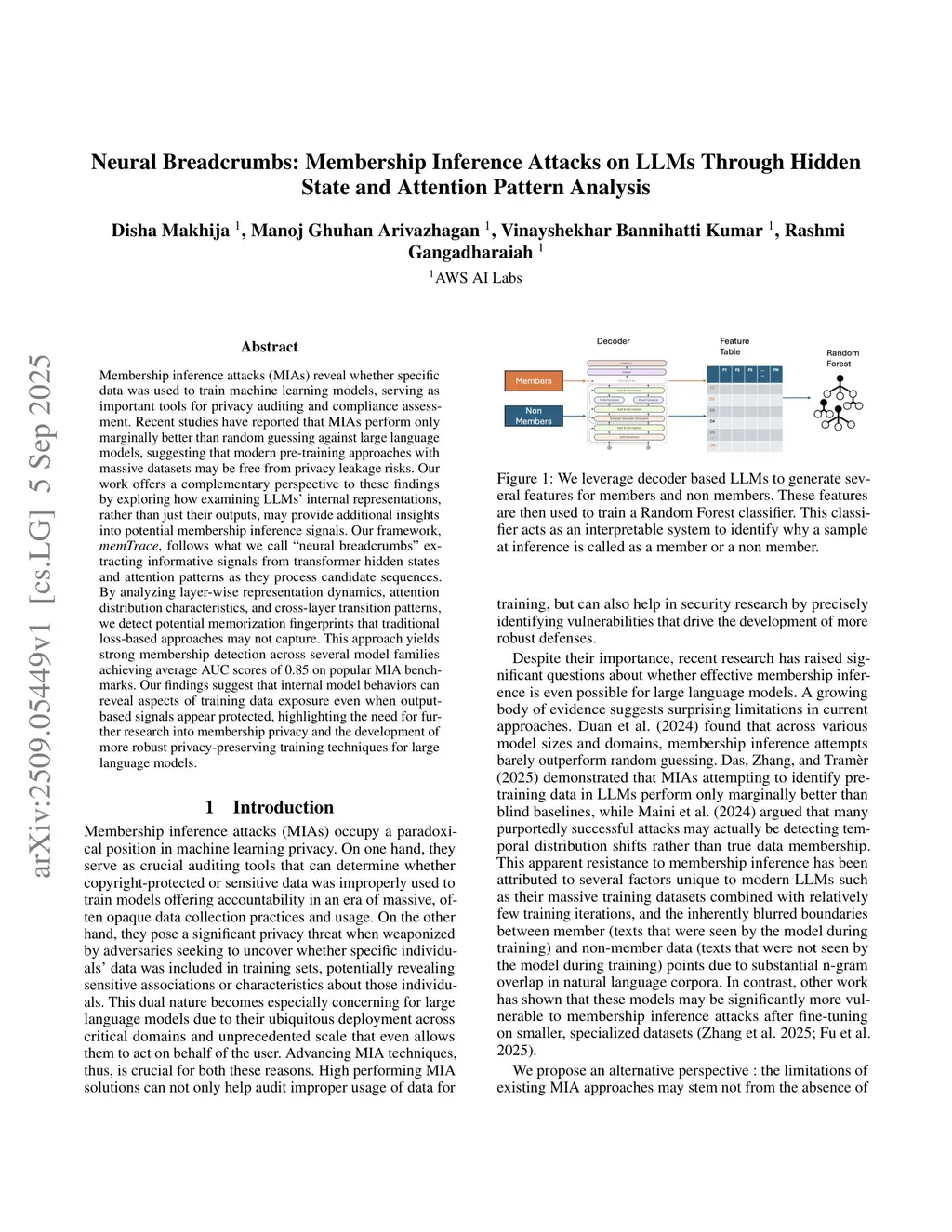
Membership inference attacks (MIAs) reveal whether specific data was used to train machine learning models, serving as important tools for privacy auditing and compliance assessment. Recent studies have reported that MIAs perform only marginally better than random guessing against large language models, suggesting that modern pre-training approaches with massive datasets may be free from privacy leakage risks. Our work offers a complementary perspective to these findings by exploring how examining LLMs' internal representations, rather than just their outputs, may provide additional insights into potential membership inference signals. Our framework, \emph{memTrace}, follows what we call \enquote{neural breadcrumbs} extracting informative signals from transformer hidden states and attention patterns as they process candidate sequences. By analyzing layer-wise representation dynamics, attention distribution characteristics, and cross-layer transition patterns, we detect potential memorization fingerprints that traditional loss-based approaches may not capture. This approach yields strong membership detection across several model families achieving average AUC scores of 0.85 on popular MIA benchmarks. Our findings suggest that internal model behaviors can reveal aspects of training data exposure even when output-based signals appear protected, highlighting the need for further research into membership privacy and the development of more robust privacy-preserving training techniques for large language models.
View on arXiv