
Finetuning LLMs for Human Behavior Prediction in Social Science Experiments
- ALM
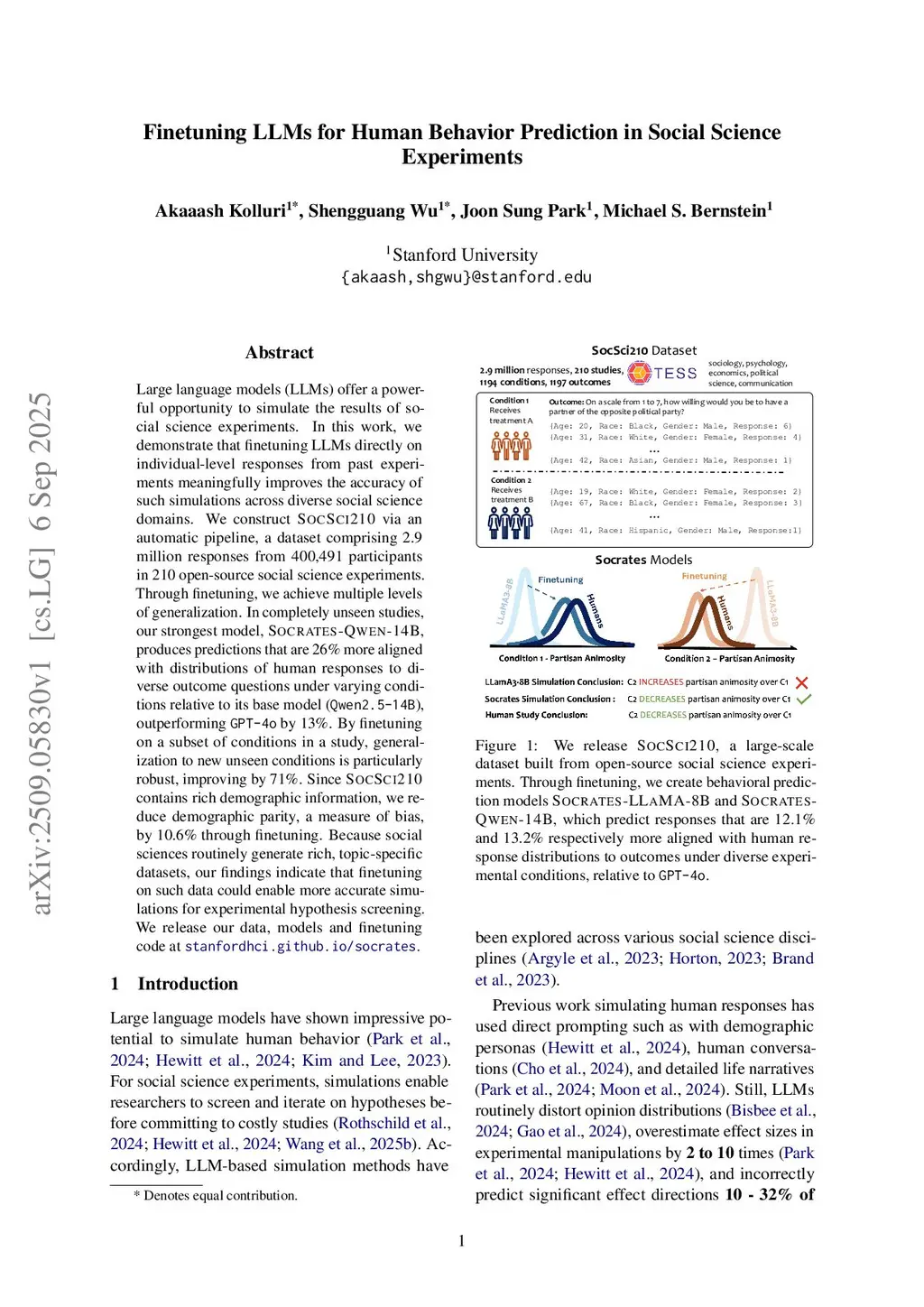
Large language models (LLMs) offer a powerful opportunity to simulate the results of social science experiments. In this work, we demonstrate that finetuning LLMs directly on individual-level responses from past experiments meaningfully improves the accuracy of such simulations across diverse social science domains. We construct SocSci210 via an automatic pipeline, a dataset comprising 2.9 million responses from 400,491 participants in 210 open-source social science experiments. Through finetuning, we achieve multiple levels of generalization. In completely unseen studies, our strongest model, Socrates-Qwen-14B, produces predictions that are 26% more aligned with distributions of human responses to diverse outcome questions under varying conditions relative to its base model (Qwen2.5-14B), outperforming GPT-4o by 13%. By finetuning on a subset of conditions in a study, generalization to new unseen conditions is particularly robust, improving by 71%. Since SocSci210 contains rich demographic information, we reduce demographic parity difference, a measure of bias, by 10.6% through finetuning. Because social sciences routinely generate rich, topic-specific datasets, our findings indicate that finetuning on such data could enable more accurate simulations for experimental hypothesis screening. We release our data, models and finetuning code atthis http URL.
View on arXiv