
Unified Multimodal Models as Auto-Encoders
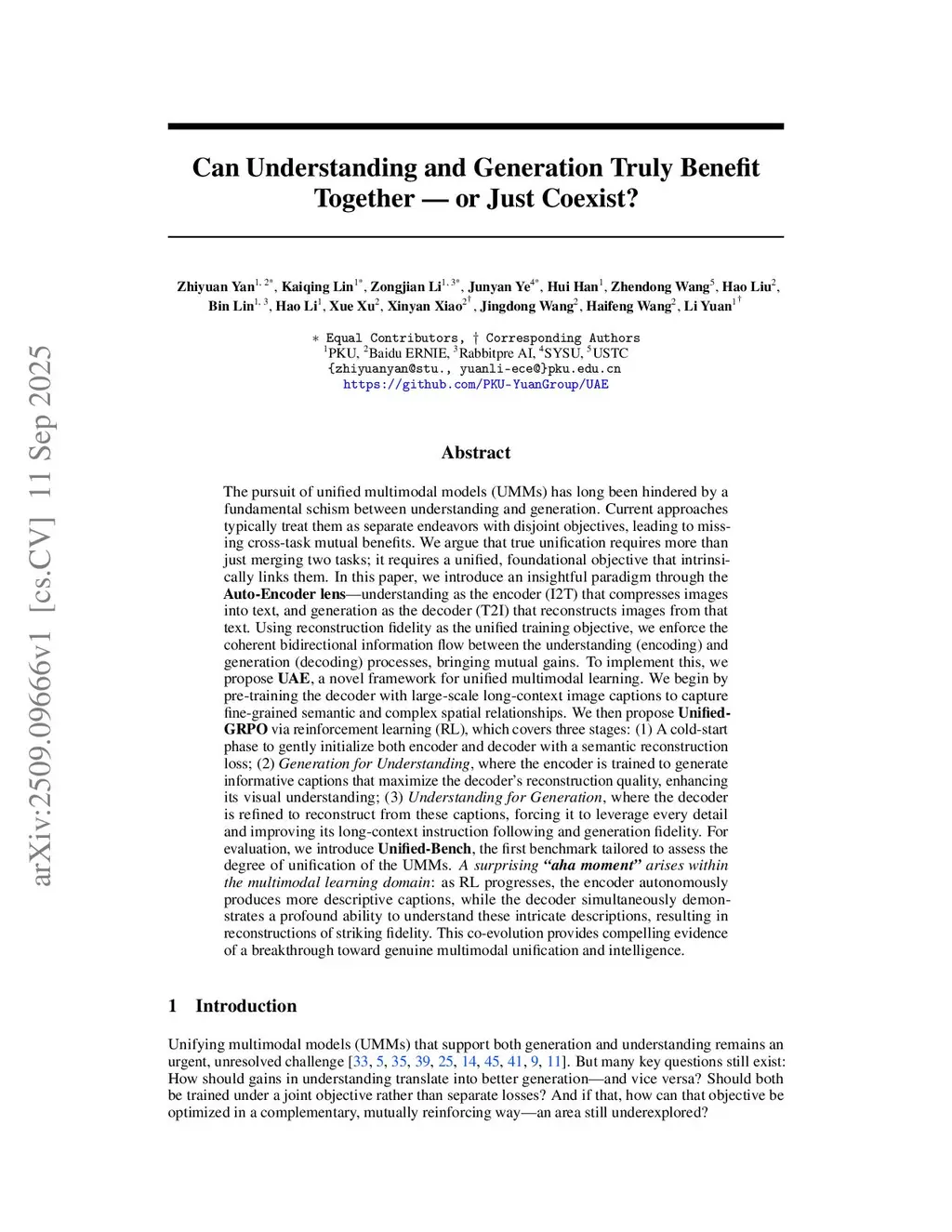
Image-to-text (I2T) understanding and text-to-image (T2I) generation are two fundamental, important yet traditionally isolated multimodal tasks. Despite their intrinsic connection, existing approaches typically optimize them independently, missing the opportunity for mutual enhancement. In this paper, we argue that the both tasks can be connected under a shared Auto-Encoder perspective, where text serves as the intermediate latent representation bridging the two directions - encoding images into textual semantics (I2T) and decoding text back into images (T2I). Our key insight is that if the encoder truly "understands" the image, it should capture all essential structure, and if the decoder truly "understands" the text, it should recover that structure faithfully. Building upon this principle, we propose Unified-GRPO, a post-training method based on reinforcement learning that jointly optimizes both modules through reconstructive rewards, maximizing the semantic consistency between the input and the generated images. Under this reconstruction objective, the encoder is encouraged to extract as much accurate and comprehensive semantic information from the input image to maximize reconstruction quality, while the decoder is simultaneously optimized to generate conditioned on the encoder's prior, enabling a self-evolving improvement. Empirically, we find that using text as the intermediate representation and training under a reconstructive RL paradigm effectively benefits both I2T and T2I. The I2T module gains stronger fine-grained visual perception, such as small-object recognition, grounding, etc, while its dense embeddings and language priors, in turn, provide richer semantic signals that improve T2I fidelity and complex instruction following. These results demonstrate that the reconstructive RL establishes a mutually reinforcing cross-modal synergy within the auto-encoding framework.
View on arXiv