
End-to-End Visual Autonomous Parking via Control-Aided Attention
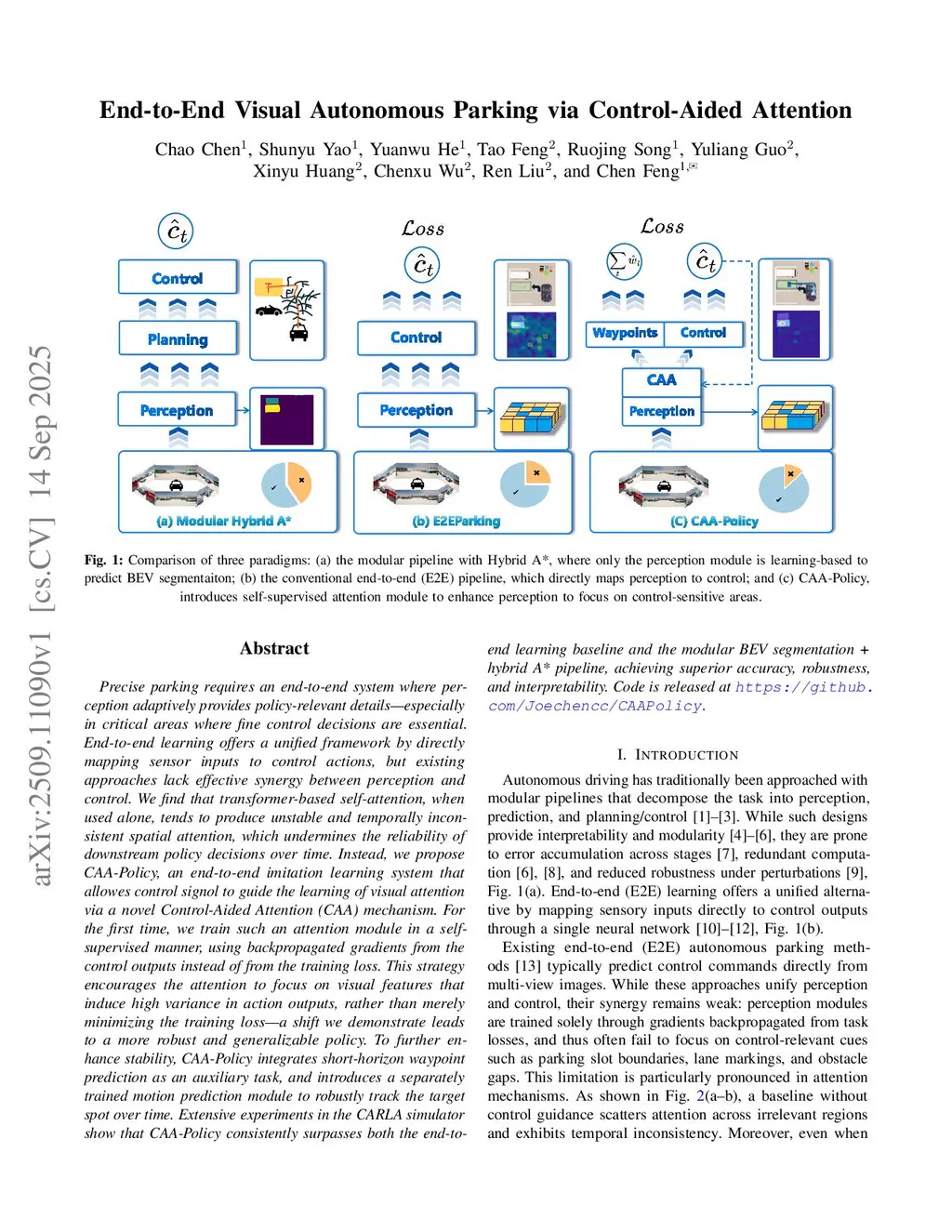
Precise parking requires an end-to-end system where perception adaptively provides policy-relevant details - especially in critical areas where fine control decisions are essential. End-to-end learning offers a unified framework by directly mapping sensor inputs to control actions, but existing approaches lack effective synergy between perception and control. Instead, we propose CAA-Policy, an end-to-end imitation learning system that allows control signal to guide the learning of visual attention via a novel Control-Aided Attention (CAA) mechanism. We train such an attention module in a self-supervised manner, using backpropagated gradients from the control outputs instead of from the training loss. This strategy encourages attention to focus on visual features that induce high variance in action outputs, rather than merely minimizing the training loss - a shift we demonstrate leads to a more robust and generalizable policy. To further strengthen the framework, CAA-Policy incorporates short-horizon waypoint prediction as an auxiliary task to improve temporal consistency of control outputs, a learnable motion prediction module to robustly track target slots over time, and a modified target tokenization scheme for more effective feature fusion. Extensive experiments in the CARLA simulator show that CAA-Policy consistently surpasses both the end-to-end learning baseline and the modular BEV segmentation + hybrid A* pipeline, achieving superior accuracy, robustness, and interpretability. Code and Collected Training datasets will be released. Code is released atthis https URL.
View on arXiv