
LLMAP: LLM-Assisted Multi-Objective Route Planning with User Preferences
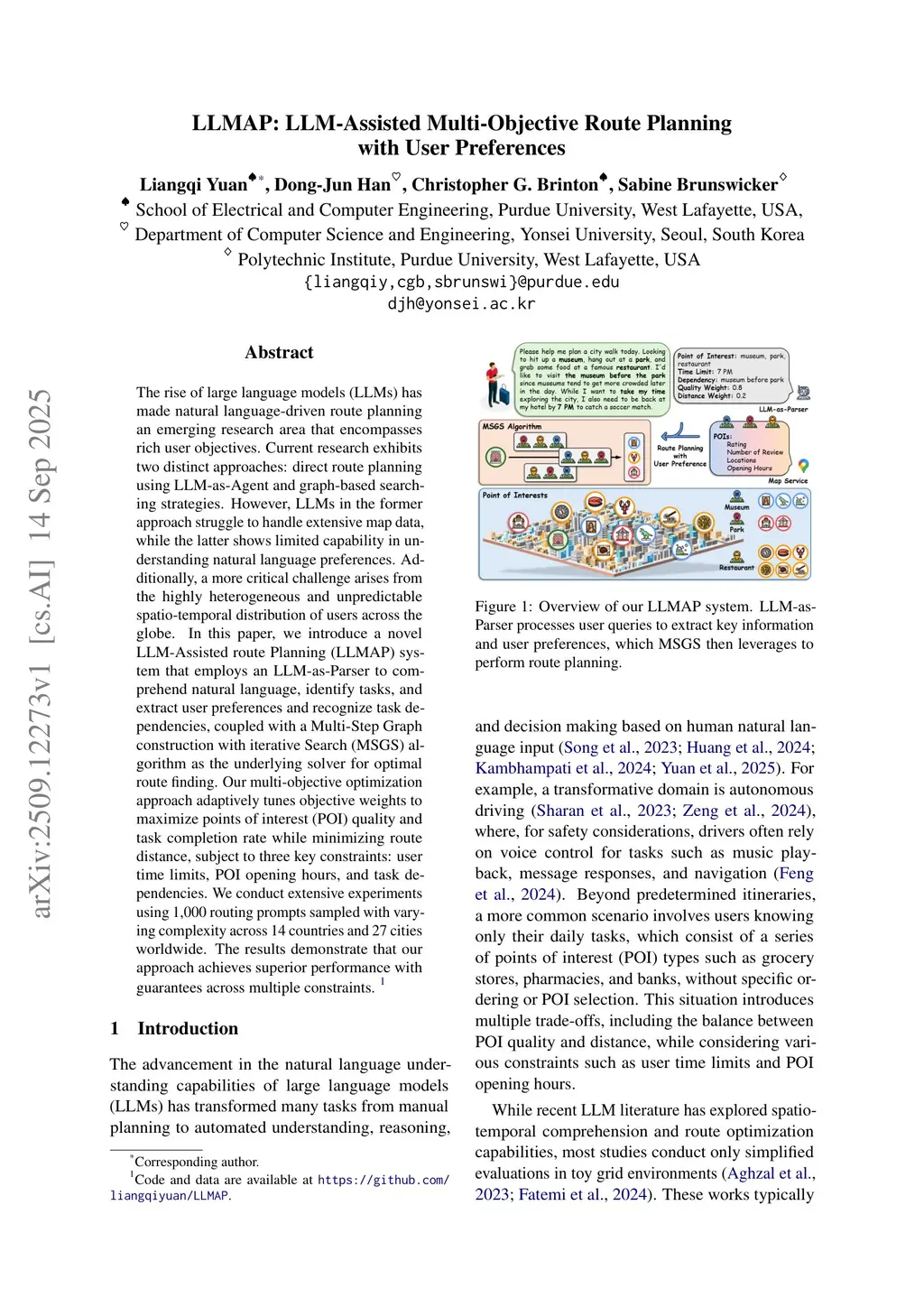
The rise of large language models (LLMs) has made natural language-driven route planning an emerging research area that encompasses rich user objectives. Current research exhibits two distinct approaches: direct route planning using LLM-as-Agent and graph-based searching strategies. However, LLMs in the former approach struggle to handle extensive map data, while the latter shows limited capability in understanding natural language preferences. Additionally, a more critical challenge arises from the highly heterogeneous and unpredictable spatio-temporal distribution of users across the globe. In this paper, we introduce a novel LLM-Assisted route Planning (LLMAP) system that employs an LLM-as-Parser to comprehend natural language, identify tasks, and extract user preferences and recognize task dependencies, coupled with a Multi-Step Graph construction with iterative Search (MSGS) algorithm as the underlying solver for optimal route finding. Our multi-objective optimization approach adaptively tunes objective weights to maximize points of interest (POI) quality and task completion rate while minimizing route distance, subject to three key constraints: user time limits, POI opening hours, and task dependencies. We conduct extensive experiments using 1,000 routing prompts sampled with varying complexity across 14 countries and 27 cities worldwide. The results demonstrate that our approach achieves superior performance with guarantees across multiple constraints.
View on arXiv