
Effective Gaussian Management for High-fidelity Object Reconstruction
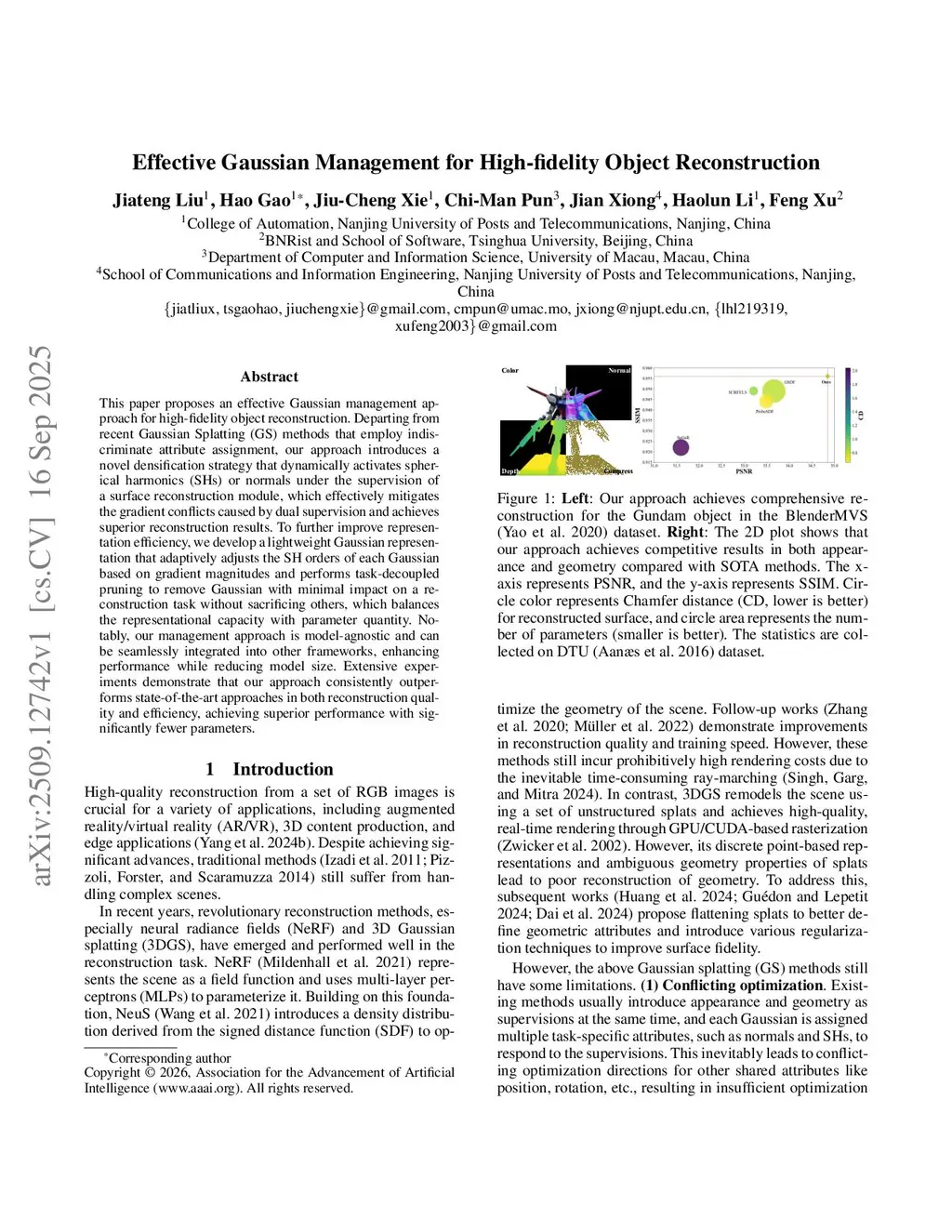
This paper presents an effective Gaussian management framework for high-fidelity scene reconstruction of appearance and geometry. Departing from recent Gaussian Splatting (GS) methods that rely on indiscriminate attribute assignment, our approach introduces a novel densification strategy called \emph{GauSep} that selectively activates Gaussian color or normal attributes. Together with a tailored rendering pipeline, termed \emph{Separate Rendering}, this strategy alleviates gradient conflicts arising from dual supervision and yields improved reconstruction quality. In addition, we develop \emph{GauRep}, an adaptive and integrated Gaussian representation that reduces redundancy both at the individual and global levels, effectively balancing model capacity and number of parameters. To provide reliable geometric supervision essential for effective management, we also introduce \emph{CoRe}, a novel surface reconstruction module that distills normal fields from the SDF branch to the Gaussian branch through a confidence mechanism. Notably, our management framework is model-agnostic and can be seamlessly incorporated into other architectures, simultaneously improving performance and reducing model size. Extensive experiments demonstrate that our approach achieves superior performance in reconstructing both appearance and geometry compared with state-of-the-art methods, while using significantly fewer parameters.
View on arXiv