
Radiolunadiff: Estimation of wireless network signal strength in lunar terrain
Main:4 Pages
3 Figures
Bibliography:1 Pages
1 Tables
Abstract
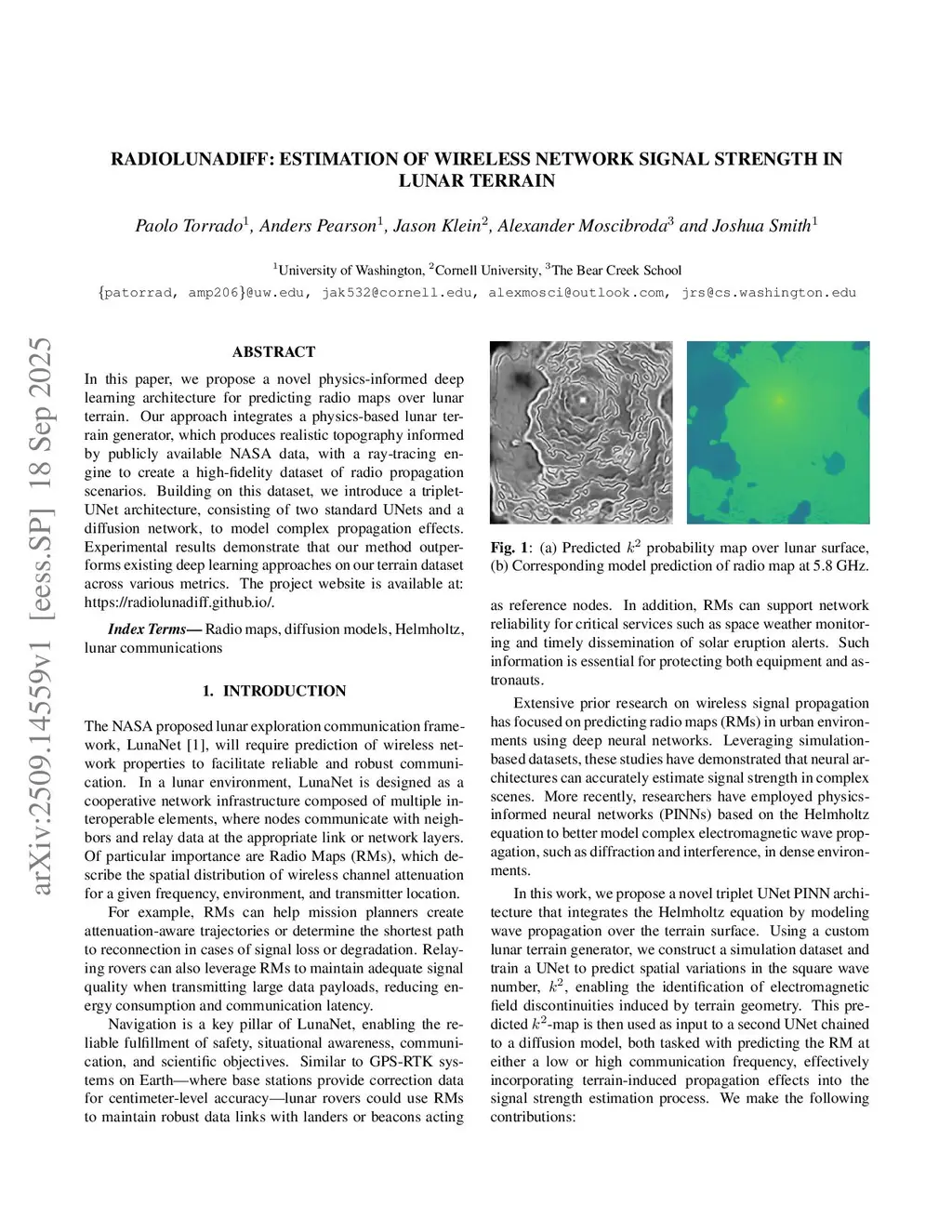
In this paper, we propose a novel physics-informed deep learning architecture for predicting radio maps over lunar terrain. Our approach integrates a physics-based lunar terrain generator, which produces realistic topography informed by publicly available NASA data, with a ray-tracing engine to create a high-fidelity dataset of radio propagation scenarios. Building on this dataset, we introduce a triplet-UNet architecture, consisting of two standard UNets and a diffusion network, to model complex propagation effects. Experimental results demonstrate that our method outperforms existing deep learning approaches on our terrain dataset across various metrics.
View on arXivComments on this paper