
Brain-HGCN: A Hyperbolic Graph Convolutional Network for Brain Functional Network Analysis
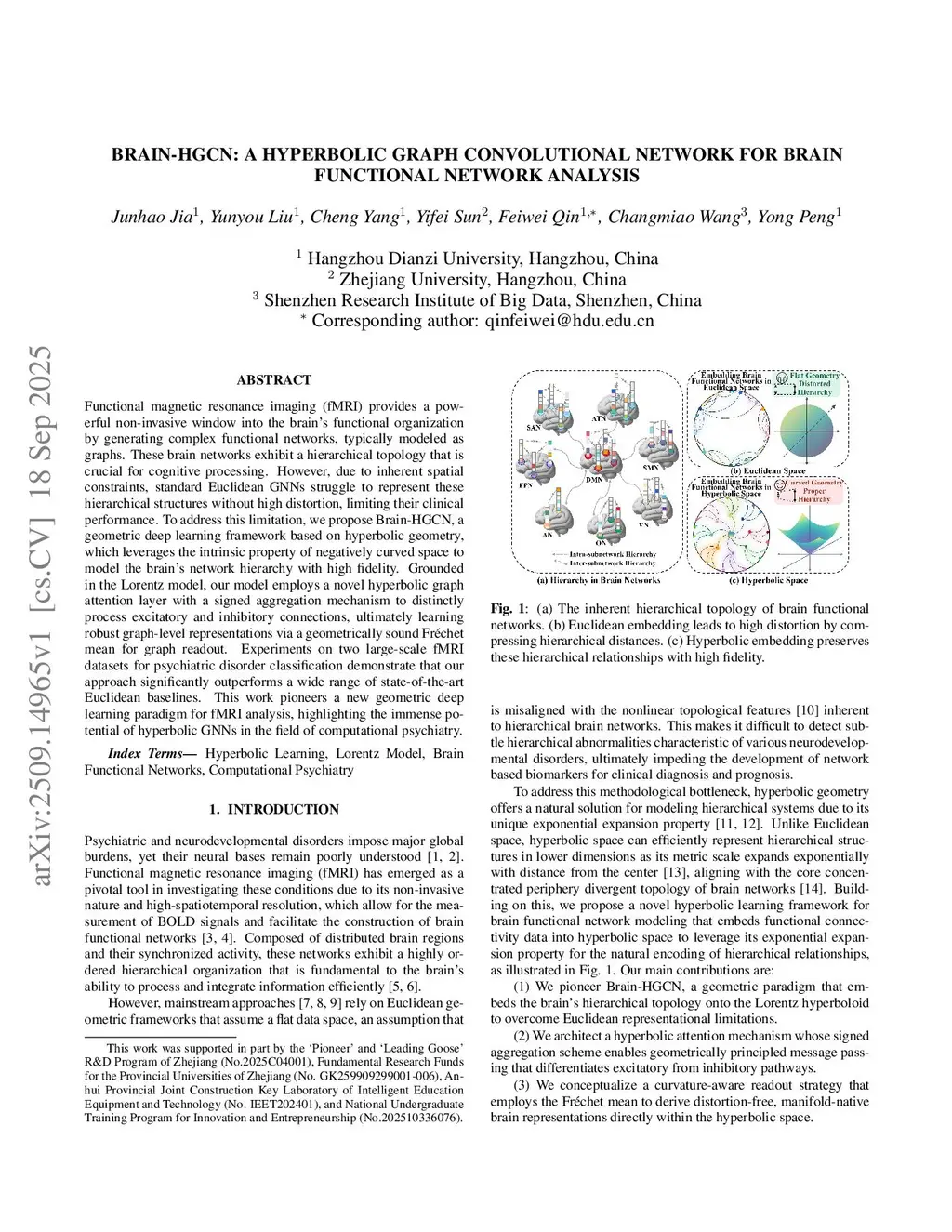
Functional magnetic resonance imaging (fMRI) reveals complex brain functional networks with hierarchical topologies crucial for cognitive processing. Standard Euclidean Graph Neural Networks (GNNs) often struggle to represent these hierarchical structures without high distortion due to inherent spatial constraints. We propose Brain-HGCN, a geometric deep learning framework based on hyperbolic geometry, which leverages negatively curved space to model brain network hierarchy with high fidelity. Grounded in the Lorentz model, our framework employs a novel hyperbolic graph attention layer with a signed aggregation mechanism to distinctly process excitatory and inhibitory connections. Furthermore, we learn robust graph-level representations via a geometrically principled Fréchet mean for graph readout. Experiments on two large-scale fMRI datasets for psychiatric disorder classification demonstrate that Brain-HGCN significantly outperforms state-of-the-art Euclidean baselines. This work highlights the potential of hyperbolic GNNs in computational psychiatry by pioneering a new geometric paradigm for fMRI analysis.
View on arXiv