
Taming Video Models for 3D and 4D Generation via Zero-Shot Camera Control
- VGen
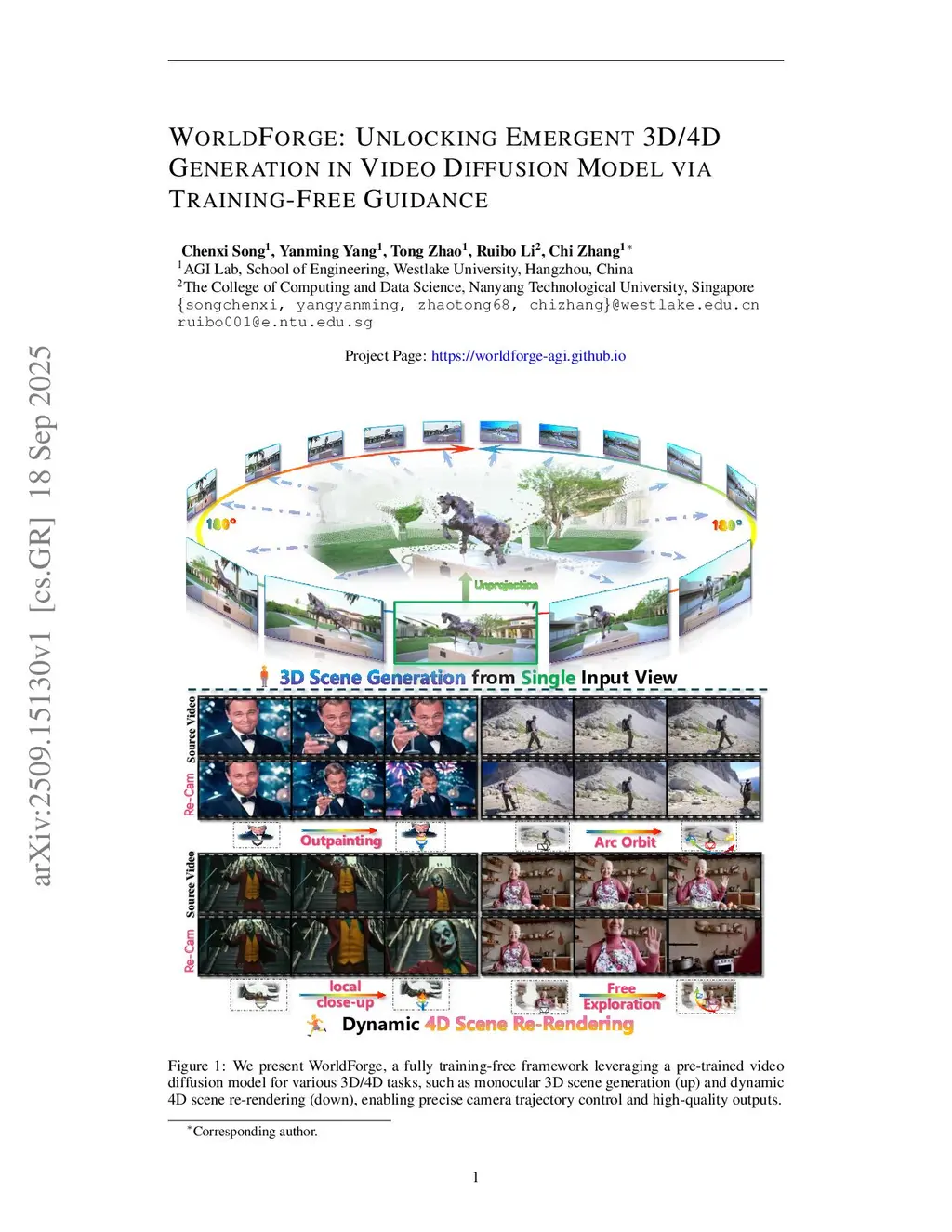
Video diffusion models have rich world priors, but their use in spatial tasks is limited by poor control, spatial-temporal inconsistent results, and entangled scene-camera dynamics. Current approaches, such as per-task fine-tuning or post-process warping, often introduce visual artifacts, fail to generalize, or incur high computational costs. We introduce WorldForge, a novel, training-free framework that operates purely at inference time to resolve these issues. Our method comprises three synergistic components. First, an intra-step refinement loop injects fine-grained motion guidance during the denoising process, iteratively correcting the output to ensure strict adherence to the target camera path. Second, an optical flow-based analysis identifies and isolates motion-related channels within the latent space. This allows our framework to selectively apply guidance, thereby decoupling motion from appearance and preserving visual fidelity. Third, a dual-path guidance strategy adaptively corrects for drift by comparing the guided generation against an unguided, reference denoising path, effectively neutralizing artifacts caused by misaligned structural inputs. Together, these components inject precise, trajectory-aligned control without model retraining, achieving accurate motion guidance and photorealistic synthesis. As a plug-and-play, model-agnostic solution, WorldForge demonstrates highly versatile generalizability. Beyond robust zero-shot 3D/4D generation, it readily empowers over a dozen diverse downstream applications, seamlessly enabling tasks like video editing, stabilization, and virtual try-on. Extensive experiments confirm state-of-the-art performance in trajectory adherence and perceptual quality, outperforming both training-dependent and inference-only baselines.
View on arXiv