
Personalized Federated Heat-Kernel Enhanced Multi-View Clustering via Advanced Tensor Decomposition Techniques
- FedML
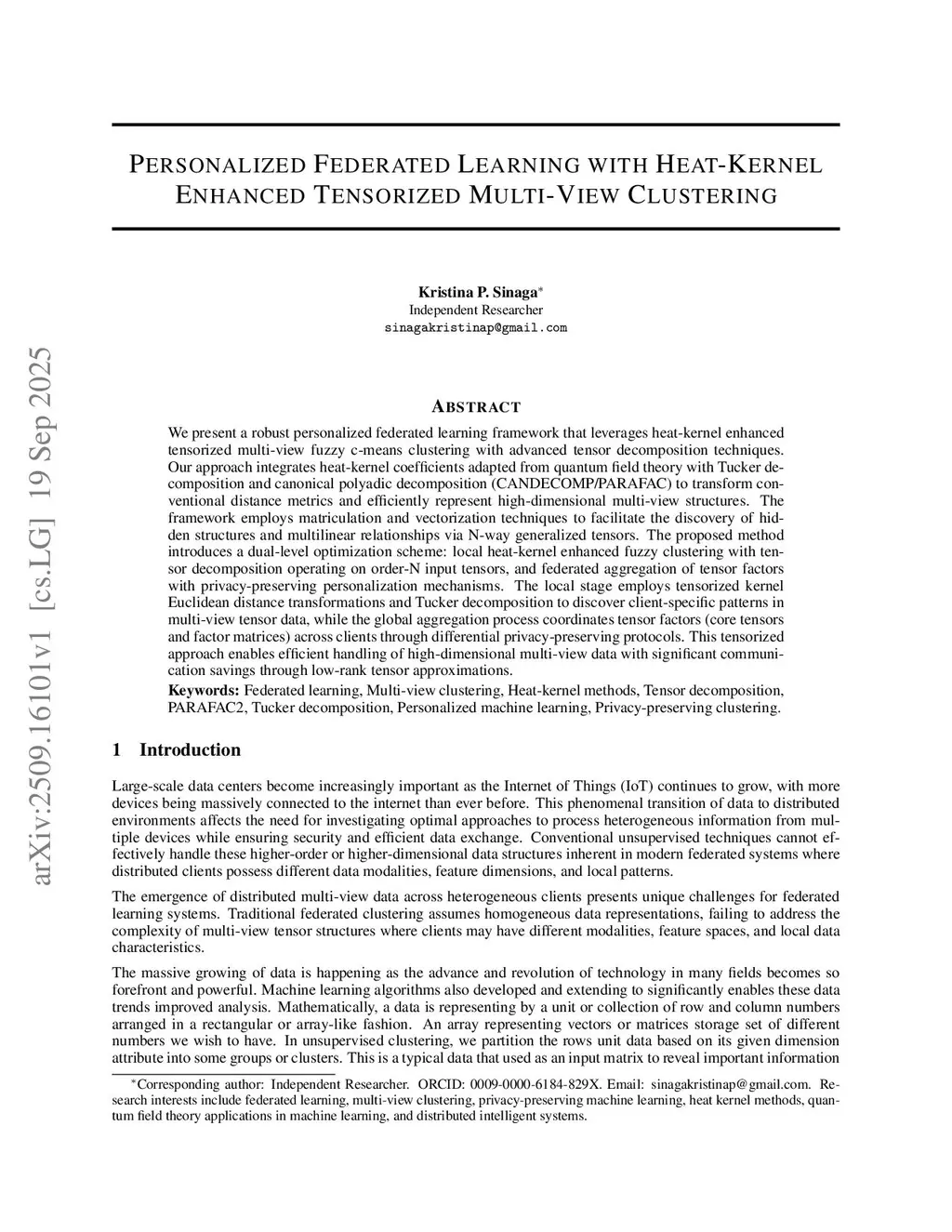
This paper introduces mathematical frameworks that address the challenges of multi-view clustering in federated learning environments. The objective is to integrate optimization techniques based on new objective functions employing heat-kernel coefficients to replace conventional distance metrics with quantum-inspired measures. The proposed frameworks utilize advanced tensor decomposition methods, specifically, PARAFAC2 and Tucker decomposition to efficiently represent high-dimensional, multi-view data while preserving inter-view relationships. The research has yielded the development of four novel algorithms, an efficient federated kernel multi-view clustering (E-FKMVC) model, FedHK-PARAFAC2, FedHK-Tucker, and FedHK-MVC-Person with PARAFAC2 Decomposition (Personalized FedHK-PARAFAC2). The primary objective of these algorithms is to enhance the efficacy of clustering processes while ensuring the confidentiality and efficient communication in federated learning environments. Theoretical analyses of convergence guarantees, privacy bounds, and complexity are provided to validate the effectiveness of the proposed methods. In essence, this paper makes a significant academic contribution to the field of federated multi-view clustering through its innovative integration of mathematical modeling and algorithm design. This approach addresses the critical challenges of data heterogeneity and privacy concerns, paving the way for enhanced data management and analytics in various contexts.
View on arXiv