
Segment-to-Act: Label-Noise-Robust Action-Prompted Video Segmentation Towards Embodied Intelligence
- VLM
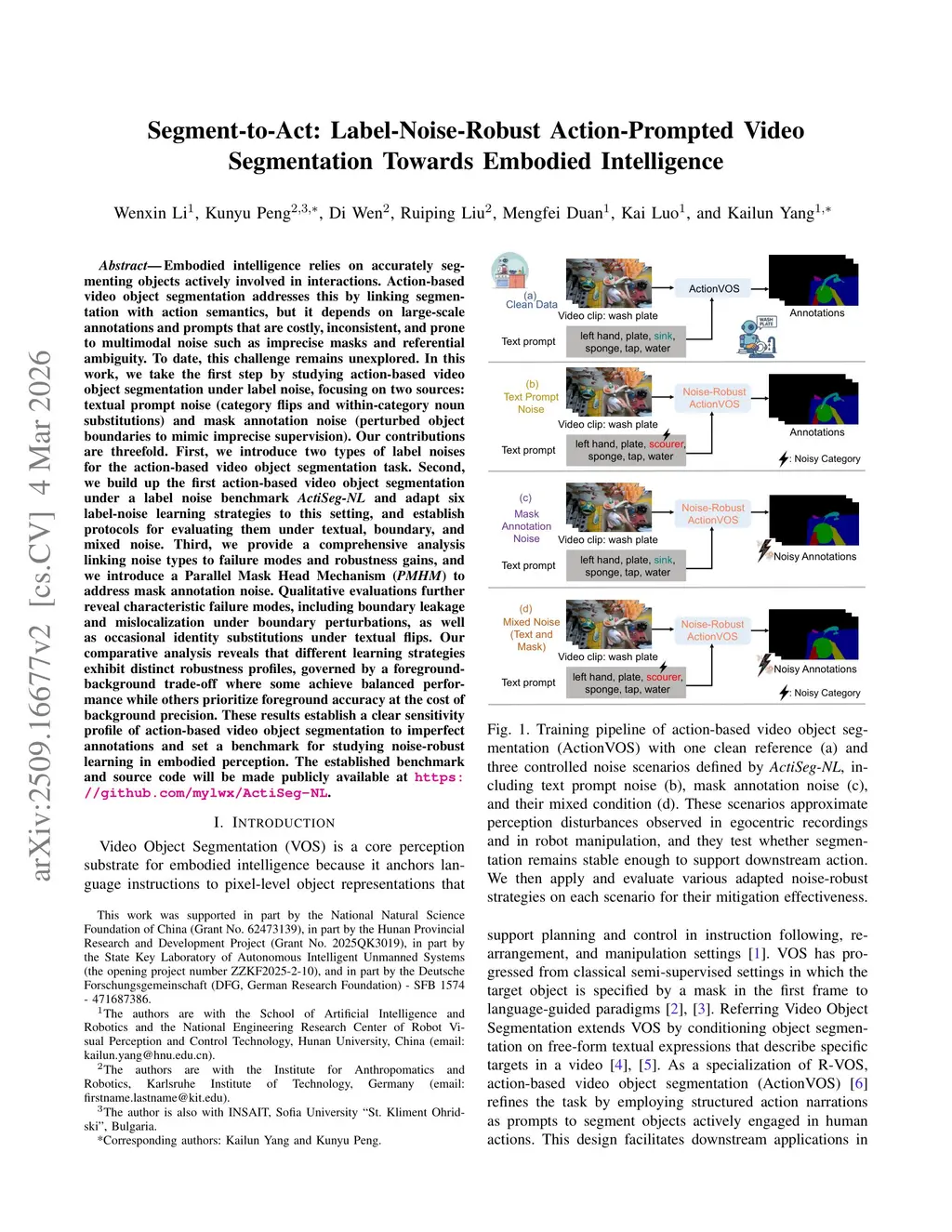
Embodied intelligence relies on accurately segmenting objects actively involved in interactions. Action-based video object segmentation addresses this by linking segmentation with action semantics, but it depends on large-scale annotations and prompts that are costly, inconsistent, and prone to multimodal noise such as imprecise masks and referential ambiguity. To date, this challenge remains unexplored. In this work, we take the first step by studying action-based video object segmentation under label noise, focusing on two sources: textual prompt noise (category flips and within-category noun substitutions) and mask annotation noise (perturbed object boundaries to mimic imprecise supervision). Our contributions are threefold. First, we introduce two types of label noises for the action-based video object segmentation task. Second, we build up the first action-based video object segmentation under a label noise benchmark ActiSeg-NL and adapt six label-noise learning strategies to this setting, and establish protocols for evaluating them under textual, boundary, and mixed noise. Third, we provide a comprehensive analysis linking noise types to failure modes and robustness gains, and we introduce a Parallel Mask Head Mechanism (PMHM) to address mask annotation noise. Qualitative evaluations further reveal characteristic failure modes, including boundary leakage and mislocalization under boundary perturbations, as well as occasional identity substitutions under textual flips. Our comparative analysis reveals that different learning strategies exhibit distinct robustness profiles, governed by a foreground-background trade-off where some achieve balanced performance while others prioritize foreground accuracy at the cost of background precision. The established benchmark and source code will be made publicly available atthis https URL.
View on arXiv