
The PIMMUR Principles: Ensuring Validity in Collective Behavior of LLM Societies
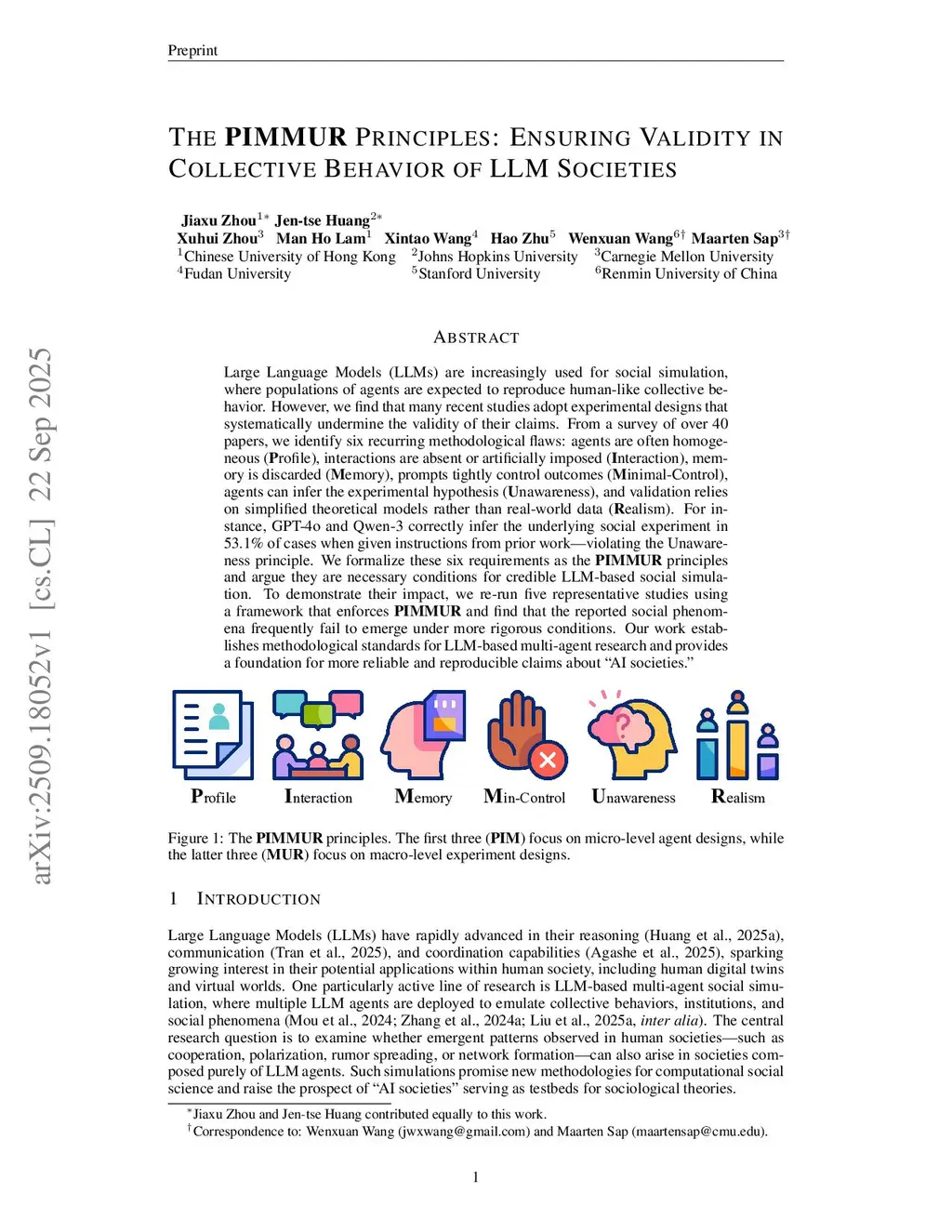
Large language models (LLMs) are increasingly deployed to simulate human collective behaviors, yet the methodological rigor of these "AI societies" remains under-explored. Through a systematic audit of 42 recent studies, we identify six pervasive flaws-spanning agent profiles, interaction, memory, control, unawareness, and realism (PIMMUR). Our analysis reveals that 90.7% of studies violate at least one principle, undermining simulation validity. We demonstrate that frontier LLMs correctly identify the underlying social experiment in 47.6% of cases, while 65.3% of prompts exert excessive control that pre-determines outcomes. By reproducing five representative experiments (e.g., telephone game), we show that reported collective phenomena often vanish or reverse when PIMMUR principles are enforced, suggesting that many "emergent" behaviors are methodological artifacts rather than genuine social dynamics. Our findings suggest that current AI simulations may capture model-specific biases rather than universal human social behaviors, raising critical concerns about the use of LLMs as scientific proxies for human society.
View on arXiv