
Similarity Field Theory: A Mathematical Framework for Intelligence
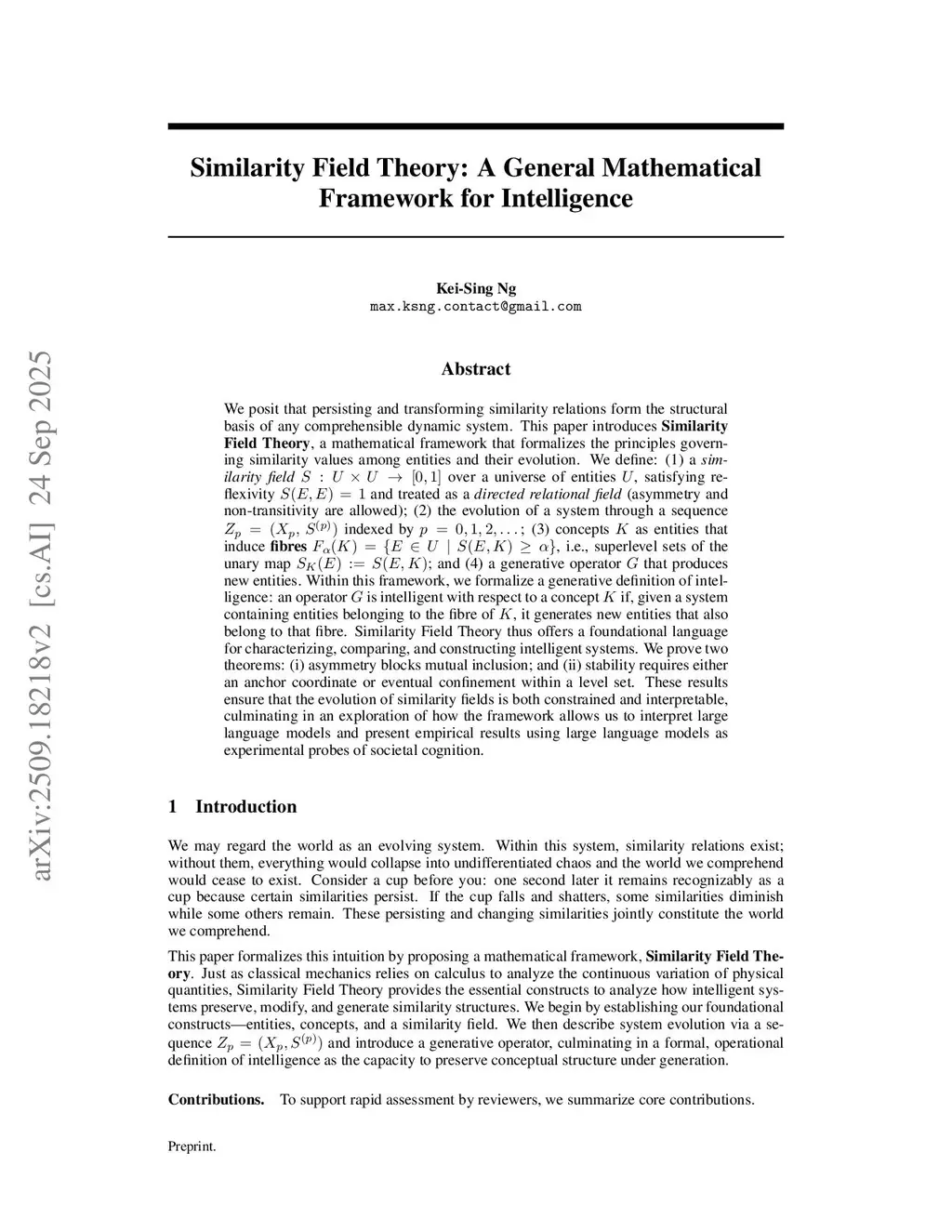
We posit that persisting and transforming similarity relations form the structural basis of any comprehensible dynamic system. This paper introduces Similarity Field Theory, a mathematical framework that formalizes the principles governing similarity values among entities and their evolution. We define: (1) a similarity field over a universe of entities , satisfying reflexivity and treated as a directed relational field (asymmetry and non-transitivity are allowed); (2) the evolution of a system through a sequence indexed by ; (3) concepts as entities that induce fibers , i.e., superlevel sets of the unary map ; and (4) a generative operator that produces new entities. Within this framework, we formalize a generative definition of intelligence: an operator is intelligent with respect to a concept if, given a system containing entities belonging to the fiber of , it generates new entities that also belong to that fiber. Similarity Field Theory thus offers a foundational language for characterizing, comparing, and constructing intelligent systems. At a high level, this framework reframes intelligence and interpretability as geometric problems on similarity fields--preserving and composing level-set fibers--rather than purely statistical ones. We prove two theorems: (i) asymmetry blocks mutual inclusion; and (ii) stability implies either an anchor coordinate or asymptotic confinement to the target level (up to arbitrarily small tolerance). Together, these results constrain similarity-field evolution and motivate an interpretive lens that can be applied to large language models.
View on arXiv