
Decision-Driven Semantic Object Exploration for Legged Robots via Confidence-Calibrated Perception and Topological Subgoal Selection
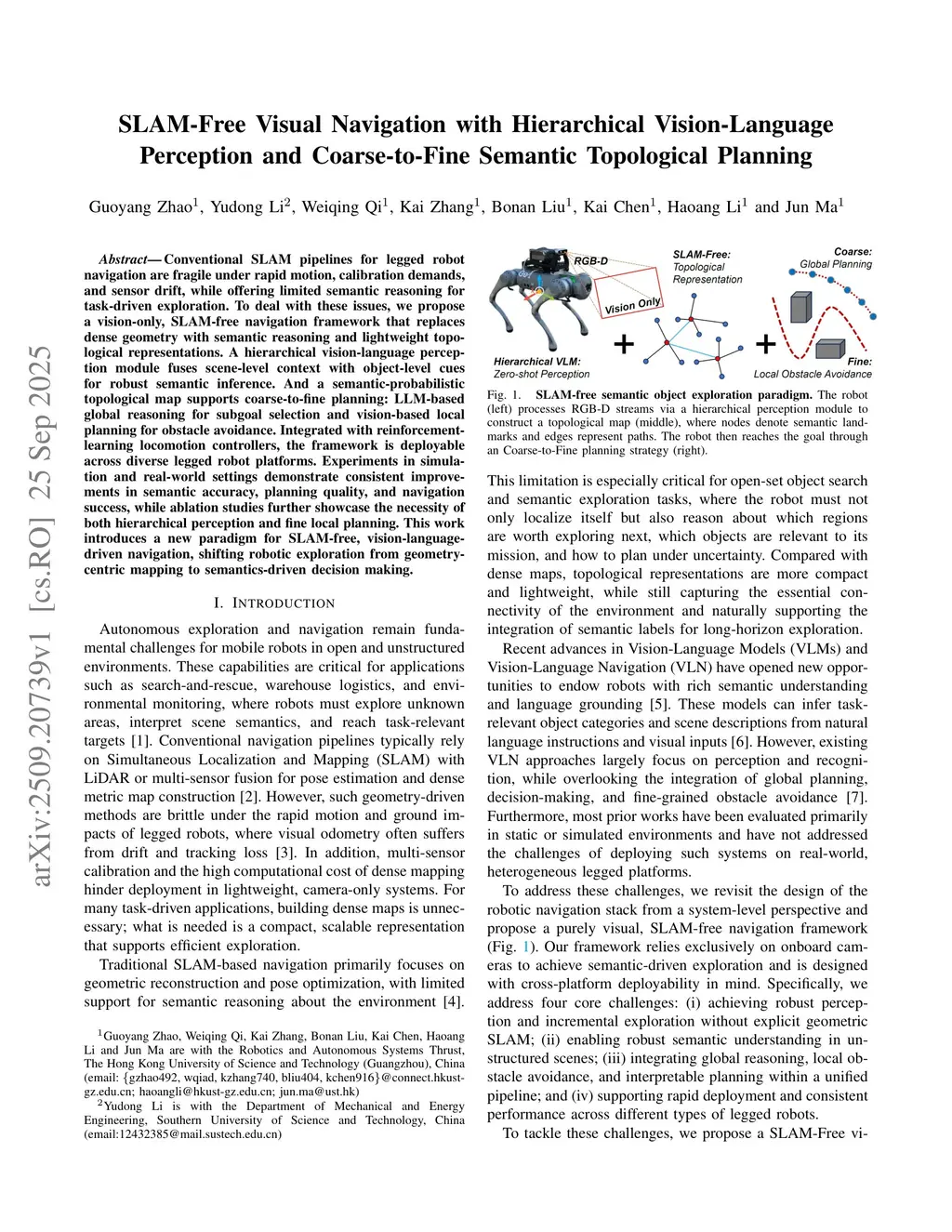
Conventional navigation pipelines for legged robots remain largely geometry-centric, relying on dense SLAM representations that are fragile under rapid motion and offer limited support for semantic decision making in open-world exploration. In this work, we focus on decision-driven semantic object exploration, where the primary challenge is not map consistency but how noisy and heterogeneous semantic observations can be transformed into stable and executable exploration decisions. We propose a vision-based approach that explicitly addresses this problem through confidence-calibrated semantic evidence arbitration, a controlled-growth semantic topological memory, and a semantic utility-driven subgoal selection mechanism. These components enable the robot to accumulate task-relevant semantic knowledge over time and select exploration targets that balance semantic relevance, reliability, and reachability, without requiring dense geometric reconstruction. Extensive experiments in both simulation and real-world environments demonstrate that the proposed mechanisms consistently improve the quality of semantic decision inputs, subgoal selection accuracy, and overall exploration performance on legged robots.
View on arXiv