
ReCon-GS: Continuum-Preserved Gaussian Streaming for Fast and Compact Reconstruction of Dynamic Scenes
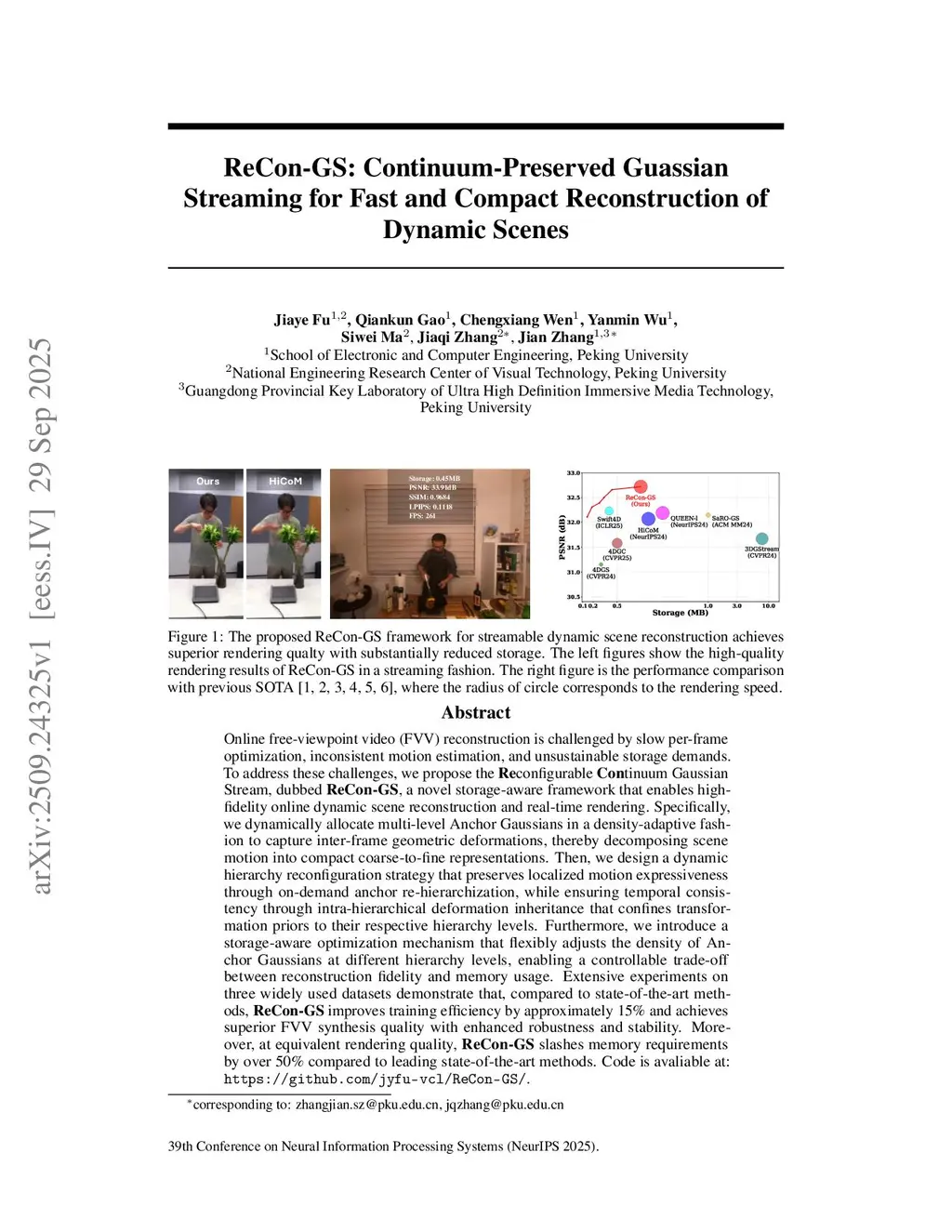
Online free-viewpoint video (FVV) reconstruction is challenged by slow per-frame optimization, inconsistent motion estimation, and unsustainable storage demands. To address these challenges, we propose the Reconfigurable Continuum Gaussian Stream, dubbed ReCon-GS, a novel storage-aware framework that enables high fidelity online dynamic scene reconstruction and real-time rendering. Specifically, we dynamically allocate multi-level Anchor Gaussians in a density-adaptive fashion to capture inter-frame geometric deformations, thereby decomposing scene motion into compact coarse-to-fine representations. Then, we design a dynamic hierarchy reconfiguration strategy that preserves localized motion expressiveness through on-demand anchor re-hierarchization, while ensuring temporal consistency through intra-hierarchical deformation inheritance that confines transformation priors to their respective hierarchy levels. Furthermore, we introduce a storage-aware optimization mechanism that flexibly adjusts the density of Anchor Gaussians at different hierarchy levels, enabling a controllable trade-off between reconstruction fidelity and memory usage. Extensive experiments on three widely used datasets demonstrate that, compared to state-of-the-art methods, ReCon-GS improves training efficiency by approximately 15% and achieves superior FVV synthesis quality with enhanced robustness and stability. Moreover, at equivalent rendering quality, ReCon-GS slashes memory requirements by over 50% compared to leading state-of-the-art methods.
View on arXiv