
HBSplat: Robust Sparse-View Gaussian Reconstruction with Hybrid-Loss Guided Depth and Bidirectional Warping
- 3DGS
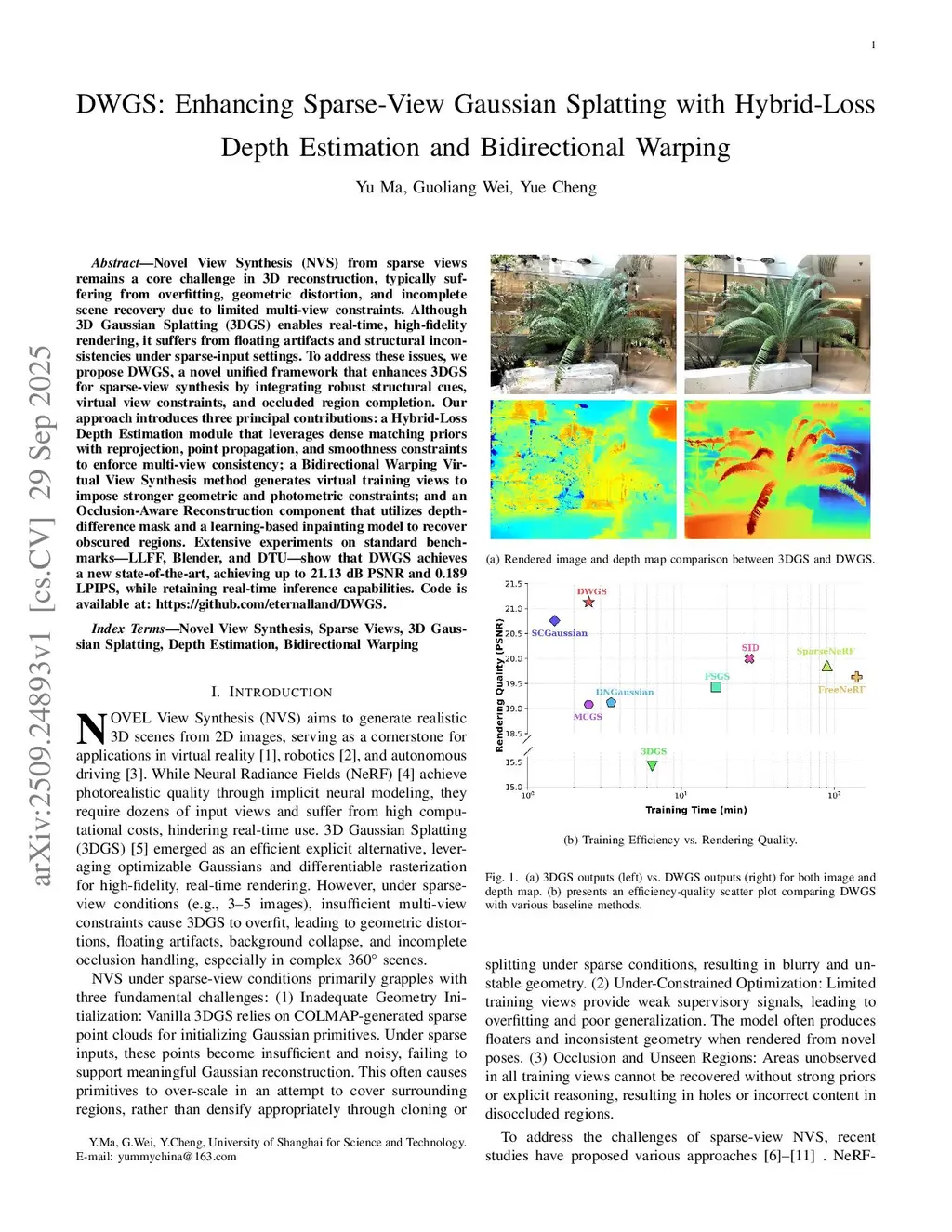
Novel View Synthesis (NVS) from sparse views presents a formidable challenge in 3D reconstruction, where limited multi-view constraints lead to severe overfitting, geometric distortion, and fragmented scenes. While 3D Gaussian Splatting (3DGS) delivers real-time, high-fidelity rendering, its performance drastically deteriorates under sparse inputs, plagued by floating artifacts and structural failures. To address these challenges, we introduce HBSplat, a unified framework that elevates 3DGS by seamlessly integrating robust structural cues, virtual view constraints, and occluded region completion. Our core contributions are threefold: a Hybrid-Loss Depth Estimation module that ensures multi-view consistency by leveraging dense matching priors and integrating reprojection, point propagation, and smoothness constraints; a Bidirectional Warping Virtual View Synthesis method that enforces substantially stronger constraints by creating high-fidelity virtual views through bidirectional depth-image warping and multi-view fusion; and an Occlusion-Aware Reconstruction component that recovers occluded areas using a depth-difference mask and a learning-based inpainting model. Extensive evaluations on LLFF, Blender, and DTU benchmarks validate that HBSplat sets a new state-of-the-art, achieving up to 21.13 dB PSNR and 0.189 LPIPS, while maintaining real-time inference. Code is available at:this https URL.
View on arXiv