
AlignTok: Aligning Visual Foundation Encoders to Tokenizers for Diffusion Models
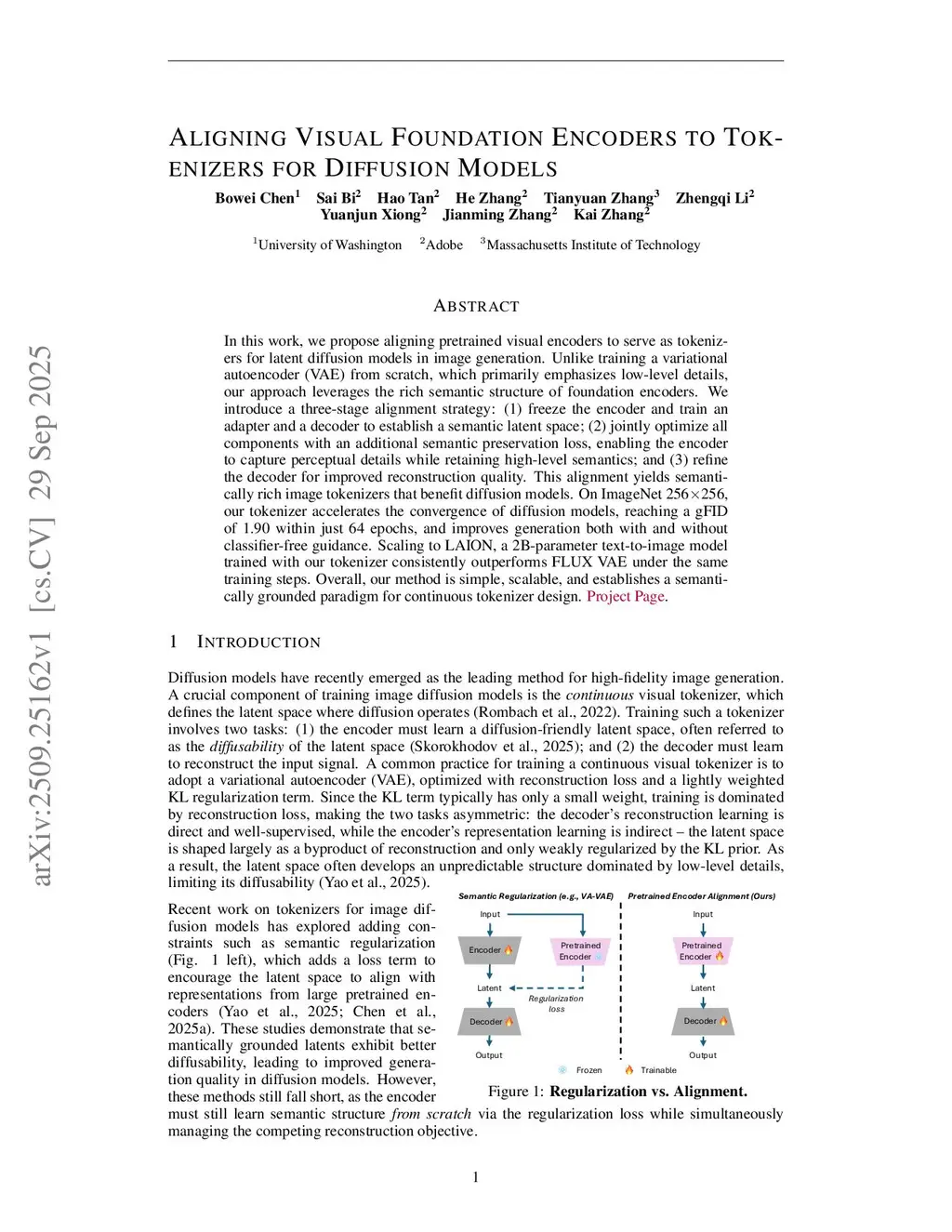
In this work, we propose aligning pretrained visual encoders to serve as tokenizers for latent diffusion models in image generation. Unlike training a variational autoencoder (VAE) from scratch, which primarily emphasizes low-level details, our approach leverages the rich semantic structure of foundation encoders. We introduce a three-stage alignment strategy called AlignTok: (1) freeze the encoder and train an adapter and a decoder to establish a semantic latent space; (2) jointly optimize all components with an additional semantic preservation loss, enabling the encoder to capture perceptual details while retaining high-level semantics; and (3) refine the decoder for improved reconstruction quality. This alignment yields semantically rich image tokenizers that benefit diffusion models. On ImageNet 256256, our tokenizer accelerates the convergence of diffusion models, reaching a gFID of 1.90 within just 64 epochs, and improves generation both with and without classifier-free guidance. Scaling to LAION, text-to-image models trained with our tokenizer consistently outperforms FLUX VAE and VA-VAE under the same training steps. Overall, our method is simple, scalable, and establishes a semantically grounded paradigm for continuous tokenizer design.
View on arXiv