
Anomaly detection for generic failure monitoring in robotic assembly, screwing and manipulation
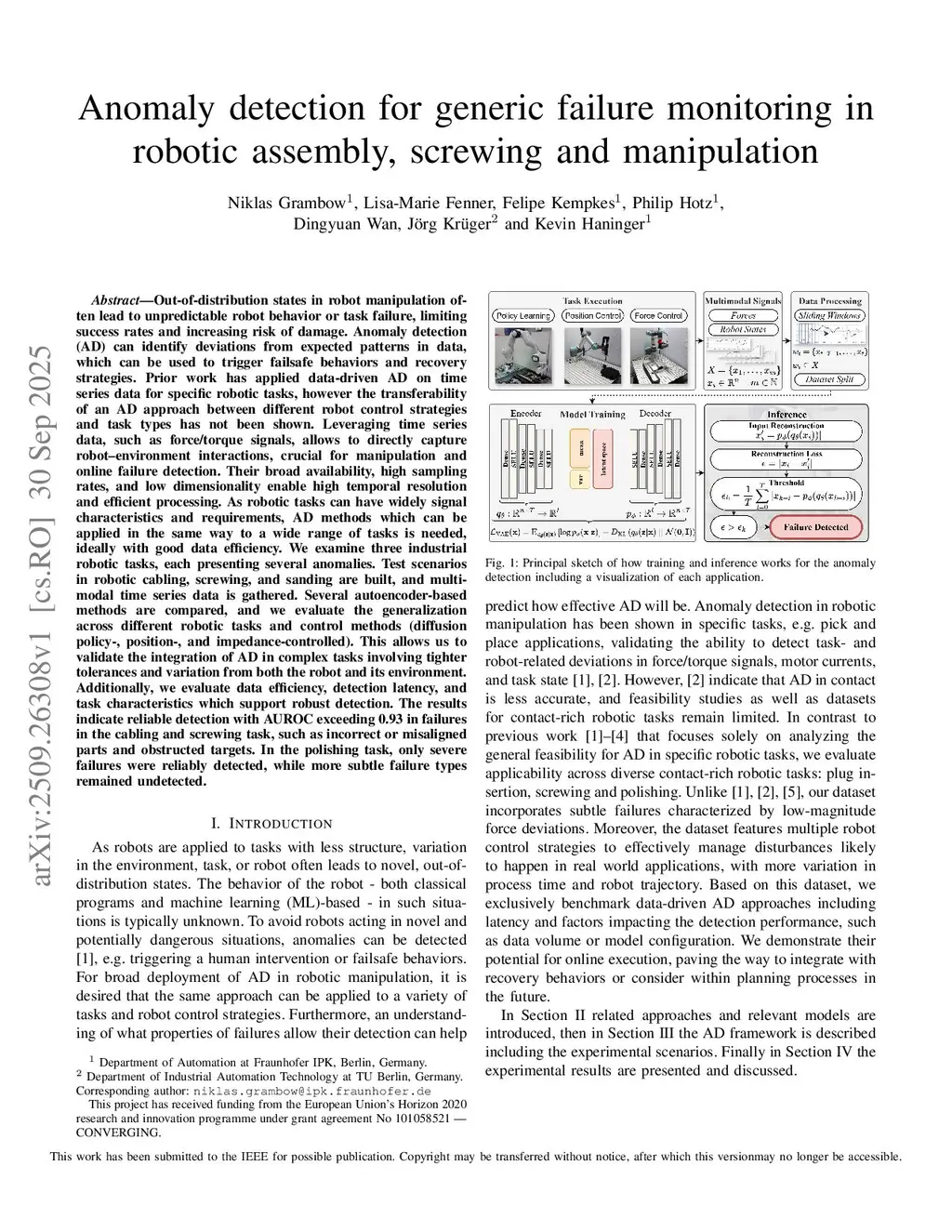
Out-of-distribution states in robot manipulation often lead to unpredictable robot behavior or task failure, limiting success rates and increasing risk of damage. Anomaly detection (AD) can identify deviations from expected patterns in data, which can be used to trigger failsafe behaviors and recovery strategies. Prior work has applied data-driven AD on time series data for specific robotic tasks, however the transferability of an AD approach between different robot control strategies and task types has not been shown. Leveraging time series data, such as force/torque signals, allows to directly capture robot-environment interactions, crucial for manipulation and online failure detection. As robotic tasks can have widely signal characteristics and requirements, AD methods which can be applied in the same way to a wide range of tasks is needed, ideally with good data efficiency. We examine three industrial robotic tasks, robotic cabling, screwing, and sanding, each with multi-modal time series data and several anomalies. Several autoencoderbased methods are compared, and we evaluate the generalization across different robotic tasks and control methods (diffusion policy-, position-, and impedance-controlled). This allows us to validate the integration of AD in complex tasks involving tighter tolerances and variation from both the robot and its environment. Additionally, we evaluate data efficiency, detection latency, and task characteristics which support robust detection. The results indicate reliable detection with AUROC exceeding 0.96 in failures in the cabling and screwing task, such as incorrect or misaligned parts and obstructed targets. In the polishing task, only severe failures were reliably detected, while more subtle failure types remained undetected.
View on arXiv