
Less is More: Lean yet Powerful Vision-Language Model for Autonomous Driving
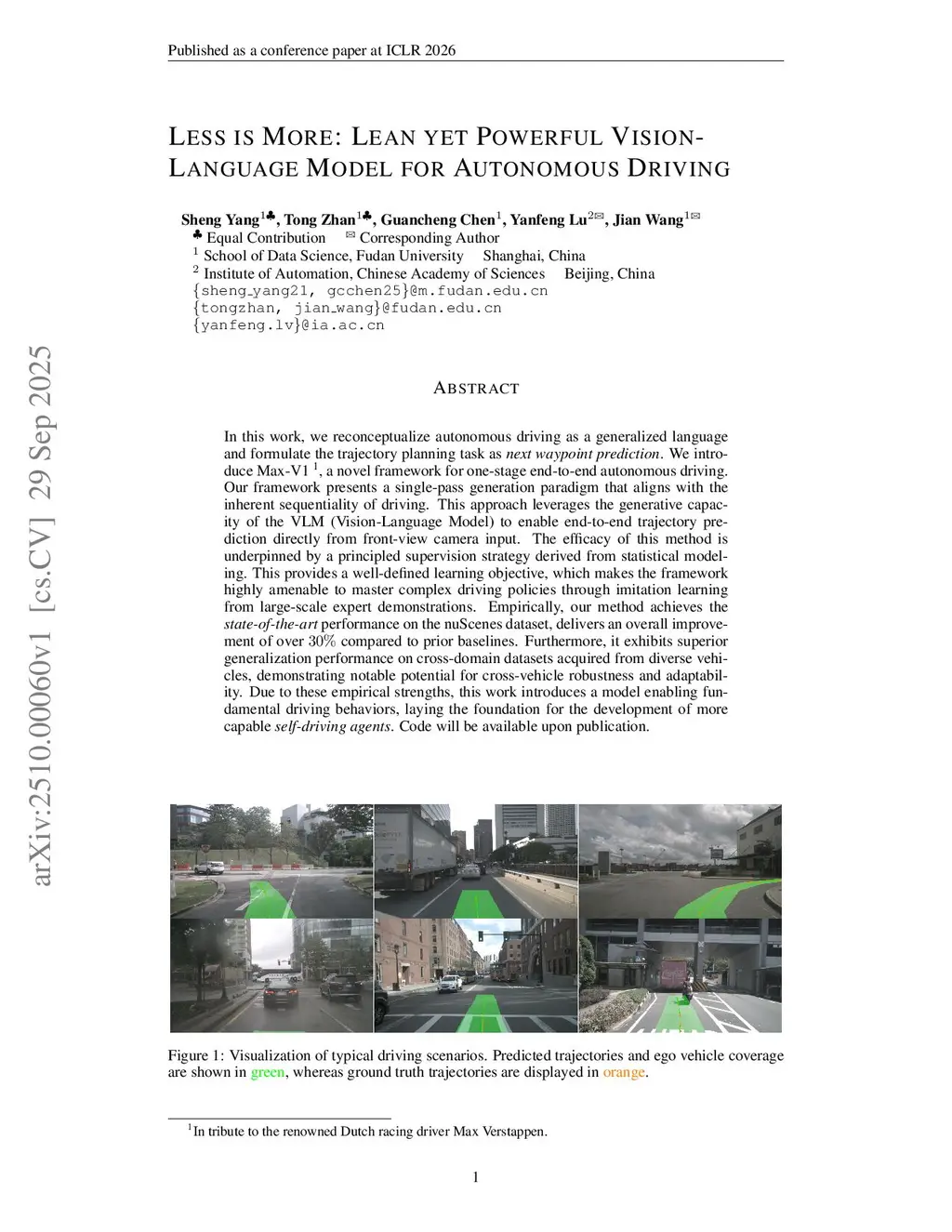
In this work, we reconceptualize autonomous driving as a generalized language problem and formulate the trajectory planning task as next waypoint prediction. We introduce Max-V1, a novel framework for one-stage end-to-end autonomous driving, named in tribute to the renowned Dutch racing driver Max Verstappen. Our framework presents a single-pass generation paradigm that aligns with the inherent sequentiality of driving. This approach leverages the generative capacity of the Vision-Language Model (VLM) to enable end-to-end trajectory prediction directly from front-view camera input. The efficacy of this method is underpinned by a principled supervision strategy derived from statistical modeling. This provides a well-defined learning objective, which makes the framework highly amenable to mastering complex driving policies through imitation learning from large-scale expert demonstrations. Empirically, our method achieves state-of-the-art performance on the nuScenes dataset, delivering an overall improvement of over 30% compared to prior baselines. Furthermore, it exhibits superior generalization performance on cross-domain datasets acquired from diverse vehicles, demonstrating notable potential for cross-vehicle robustness and adaptability. With these empirical strengths, this work introduces a model that enables fundamental driving behaviors, laying the foundation for the development of more capable self-driving agents. Code will be available upon publication.
View on arXiv