
FideDiff: Efficient Diffusion Model for High-Fidelity Image Motion Deblurring
- DiffM
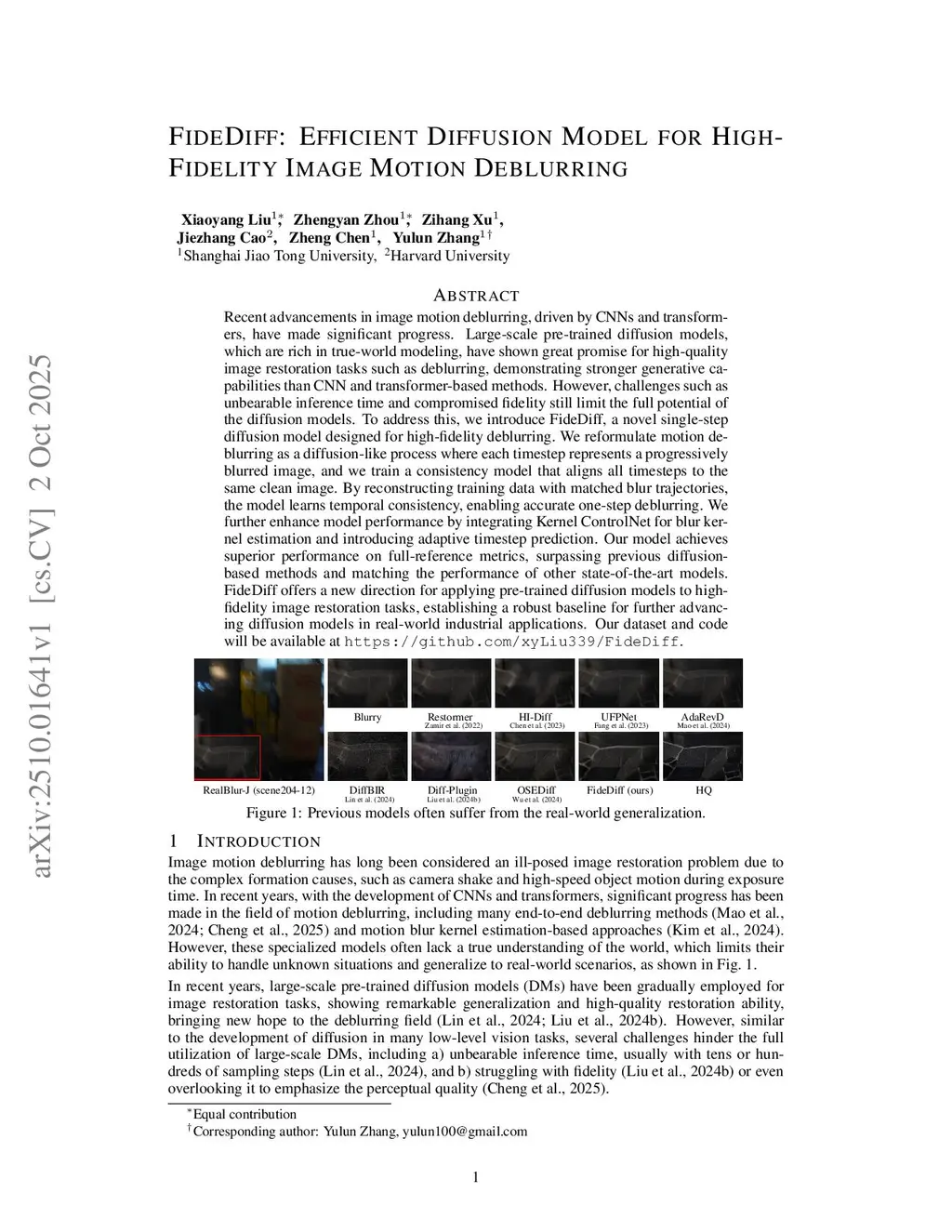
Recent advancements in image motion deblurring, driven by CNNs and transformers, have made significant progress. Large-scale pre-trained diffusion models, which are rich in true-world modeling, have shown great promise for high-quality image restoration tasks such as deblurring, demonstrating stronger generative capabilities than CNN and transformer-based methods. However, challenges such as unbearable inference time and compromised fidelity still limit the full potential of the diffusion models. To address this, we introduce FideDiff, a novel single-step diffusion model designed for high-fidelity deblurring. We reformulate motion deblurring as a diffusion-like process where each timestep represents a progressively blurred image, and we train a consistency model that aligns all timesteps to the same clean image. By reconstructing training data with matched blur trajectories, the model learns temporal consistency, enabling accurate one-step deblurring. We further enhance model performance by integrating Kernel ControlNet for blur kernel estimation and introducing adaptive timestep prediction. Our model achieves superior performance on full-reference metrics, surpassing previous diffusion-based methods and matching the performance of other state-of-the-art models. FideDiff offers a new direction for applying pre-trained diffusion models to high-fidelity image restoration tasks, establishing a robust baseline for further advancing diffusion models in real-world industrial applications. Our dataset and code will be available atthis https URL.
View on arXiv