
FOCUS: Optimal Control for Multi-Entity World Modeling in Text-to-Image Generation
- VGen
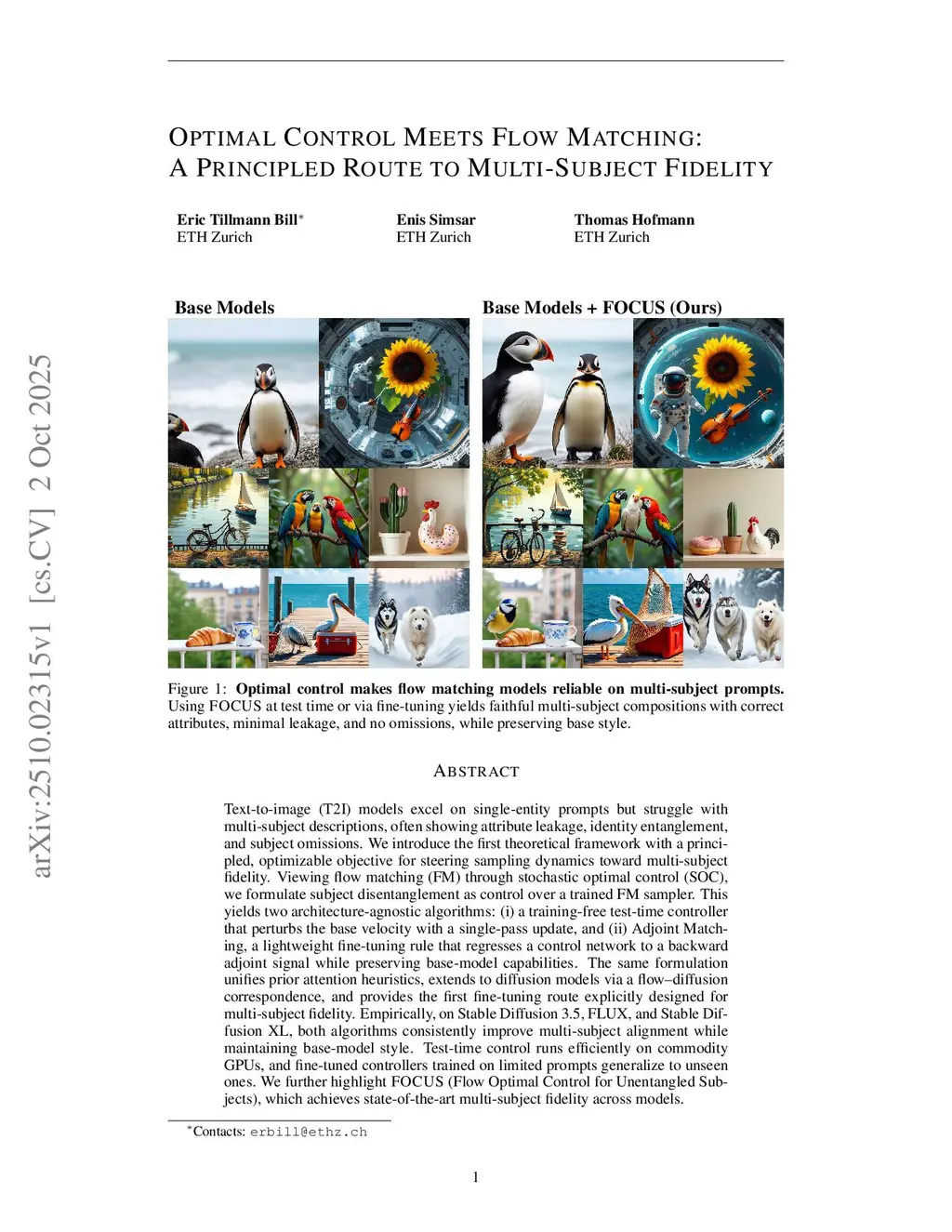
Text-to-image (T2I) models excel on single-entity prompts but struggle with multi-entity scenes, often exhibiting attribute leakage, identity entanglement, and subject omissions. We present a principled theoretical framework that steers sampling toward multi-subject fidelity by casting flow matching (FM) as stochastic optimal control (SOC), yielding a single hyperparameter controlled trade-off between fidelity and object-centric state separation / binding consistency. Within this framework, we derive two architecture-agnostic algorithms: (i) a training-free test-time controller that perturbs the base velocity with a single-pass update, and (ii) Adjoint Matching, a lightweight fine-tuning rule that regresses a control network to a backward adjoint signal. The same formulation unifies prior attention heuristics, extends to diffusion models via a flow--diffusion correspondence, and provides the first fine-tuning route explicitly designed for multi-subject fidelity. In addition, we also introduce FOCUS (Flow Optimal Control for Unentangled Subjects), a probabilistic attention-binding objective compatible with both algorithms. Empirically, on Stable Diffusion 3.5 and FLUX.1, both algorithms consistently improve multi-subject alignment while maintaining base-model style; test-time control runs efficiently on commodity GPUs, and fine-tuned models generalize to unseen prompts.
View on arXiv