
Pivotal CLTs for Pseudolikelihood via Conditional Centering in Dependent Random Fields
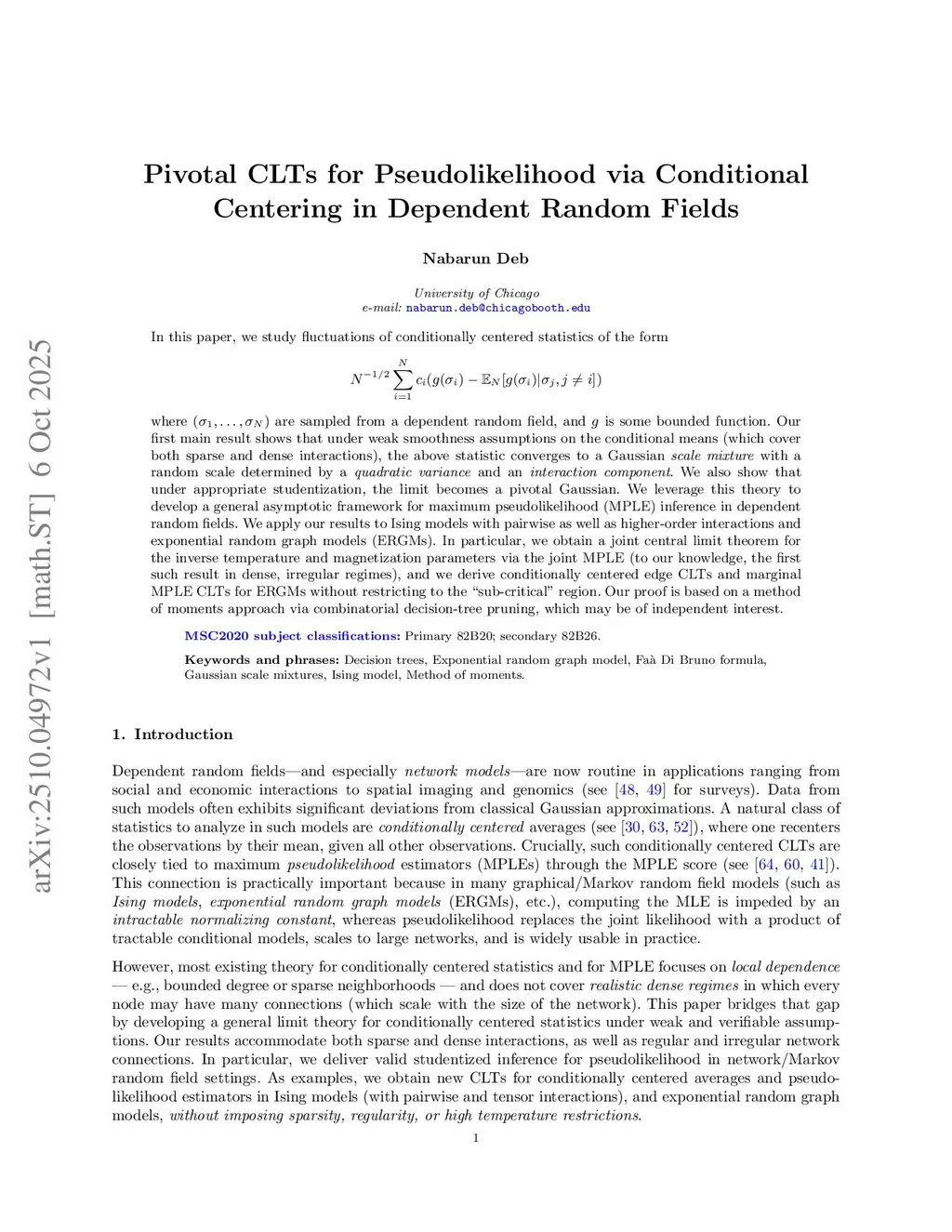
In this paper, we study fluctuations of conditionally centered statistics of the form where are sampled from a dependent random field, and is some bounded function. Our first main result shows that under weak smoothness assumptions on the conditional means (which cover both sparse and dense interactions), the above statistic converges to a Gaussian \emph{scale mixture} with a random scale determined by a \emph{quadratic variance} and an \emph{interaction component}. We also show that under appropriate studentization, the limit becomes a pivotal Gaussian. We leverage this theory to develop a general asymptotic framework for maximum pseudolikelihood (MPLE) inference in dependent random fields. We apply our results to Ising models with pairwise as well as higher-order interactions and exponential random graph models (ERGMs). In particular, we obtain a joint central limit theorem for the inverse temperature and magnetization parameters via the joint MPLE (to our knowledge, the first such result in dense, irregular regimes), and we derive conditionally centered edge CLTs and marginal MPLE CLTs for ERGMs without restricting to the ``sub-critical" region. Our proof is based on a method of moments approach via combinatorial decision-tree pruning, which may be of independent interest.
View on arXiv