
Self-Filtered Distillation with LLMs-generated Trust Indicators for Reliable Patent Classification
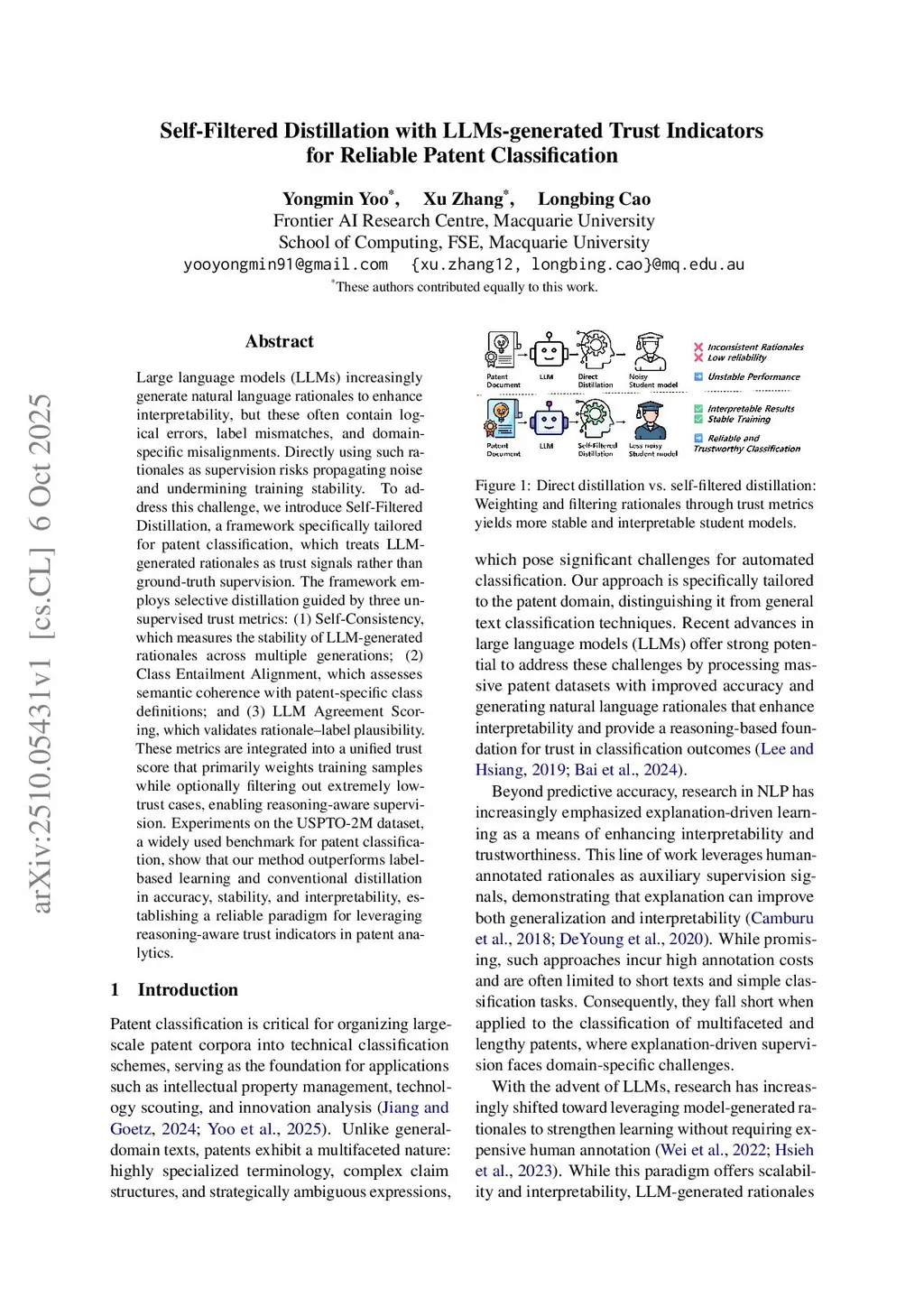
Large language models (LLMs) increasingly generate natural language rationales to enhance interpretability, but these often contain logical errors, label mismatches, and domain-specific misalignments. Directly using such rationales as supervision risks propagating noise and undermining training stability. To address this challenge, we introduce Self-Filtered Distillation, a framework tailored for patent classification that treats LLM-generated rationales as trust signals rather than ground-truth supervision. The framework employs selective distillation guided by three unsupervised trust metrics: (1) Self-Consistency, which measures the stability of LLM-generated rationales across multiple generations; (2) Class Entailment Alignment, which assesses semantic coherence with patent-specific class definitions; and (3) LLM Agreement Scoring, which validates rationale-label plausibility. These metrics are integrated into a unified trust score that primarily weights training samples while optionally filtering out extremely low-trust cases, enabling reasoning-aware supervision. Experiments on the USPTO-2M dataset show that our method consistently outperforms label-based learning and conventional distillation in accuracy, stability, and interpretability across diverse student architectures, establishing a reliable paradigm for leveraging reasoning-aware trust indicators in patent analytics.
View on arXiv