
GraphGhost: Tracing Structures Behind Large Language Models
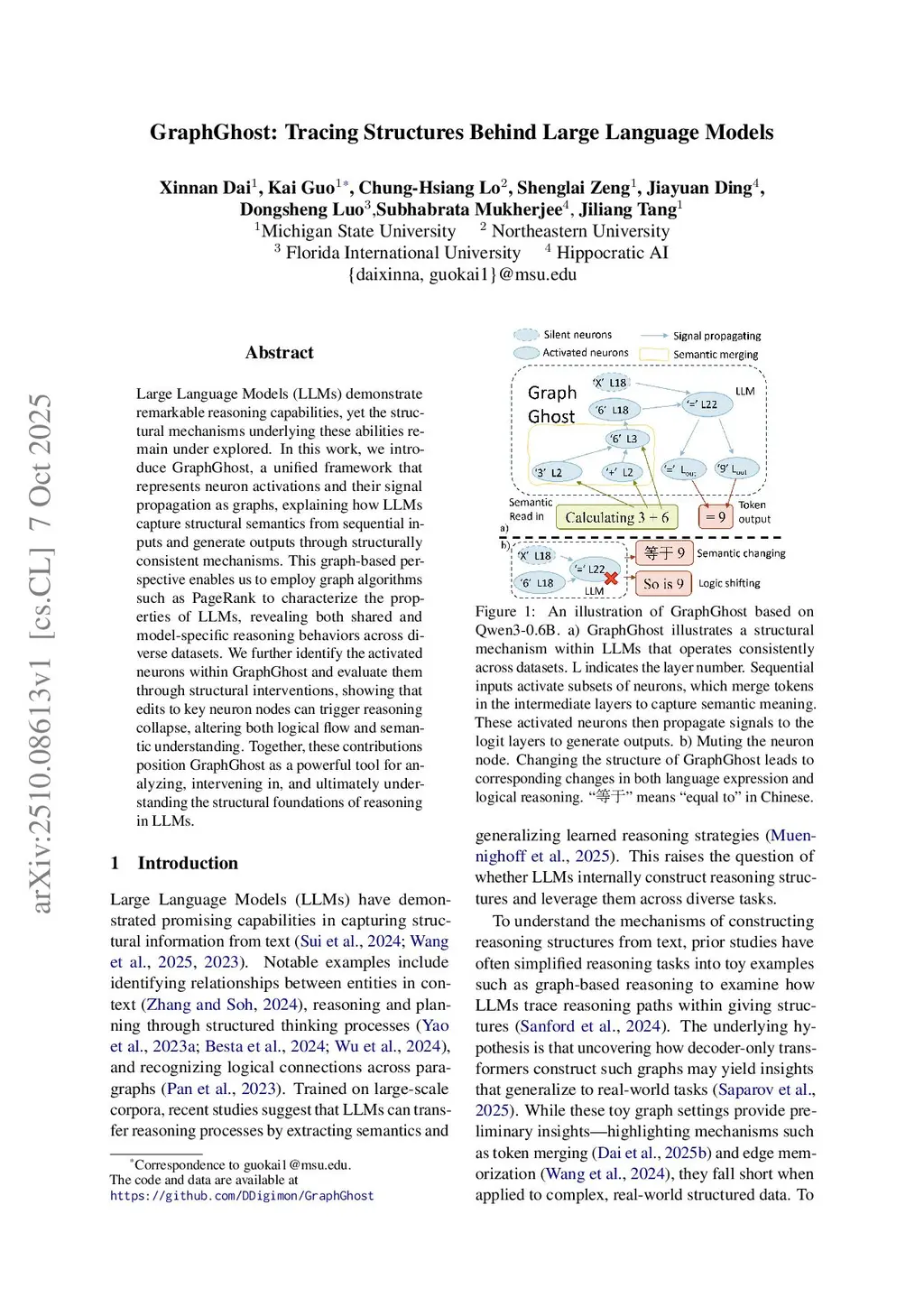
Large Language Models (LLMs) exhibit strong reasoning capabilities on structured tasks, yet the internal mechanisms underlying such behaviors remain poorly understood. Existing interpretation methods mainly focus on token-level attributions, which provide limited insight into multi-step reasoning inside the model. We propose GraphGhost, a graph-based framework that models internal token interactions and neuron activations in LLMs as graphs. By aggregating token dependencies traced across layers, GraphGhost captures global information flow underlying model predictions. We formalize GraphGhost from two complementary perspectives: a sample view, which traces token dependencies for individual predictions, and a dataset view, which aggregates recurring structural patterns learned during training. Through graph analytics and quantitative experiments, we show that graph structural properties are closely associated with influential tokens and neuron nodes, and that perturbations to structurally critical nodes lead to measurable changes in reasoning behavior. These results indicate that the structural patterns captured by GraphGhost reflect meaningful internal organization of LLM reasoning. The codes are available at software part. Artifacts will be made available for research use only.
View on arXiv