
Regret Bounds for Adversarial Contextual Bandits with General Function Approximation and Delayed Feedback
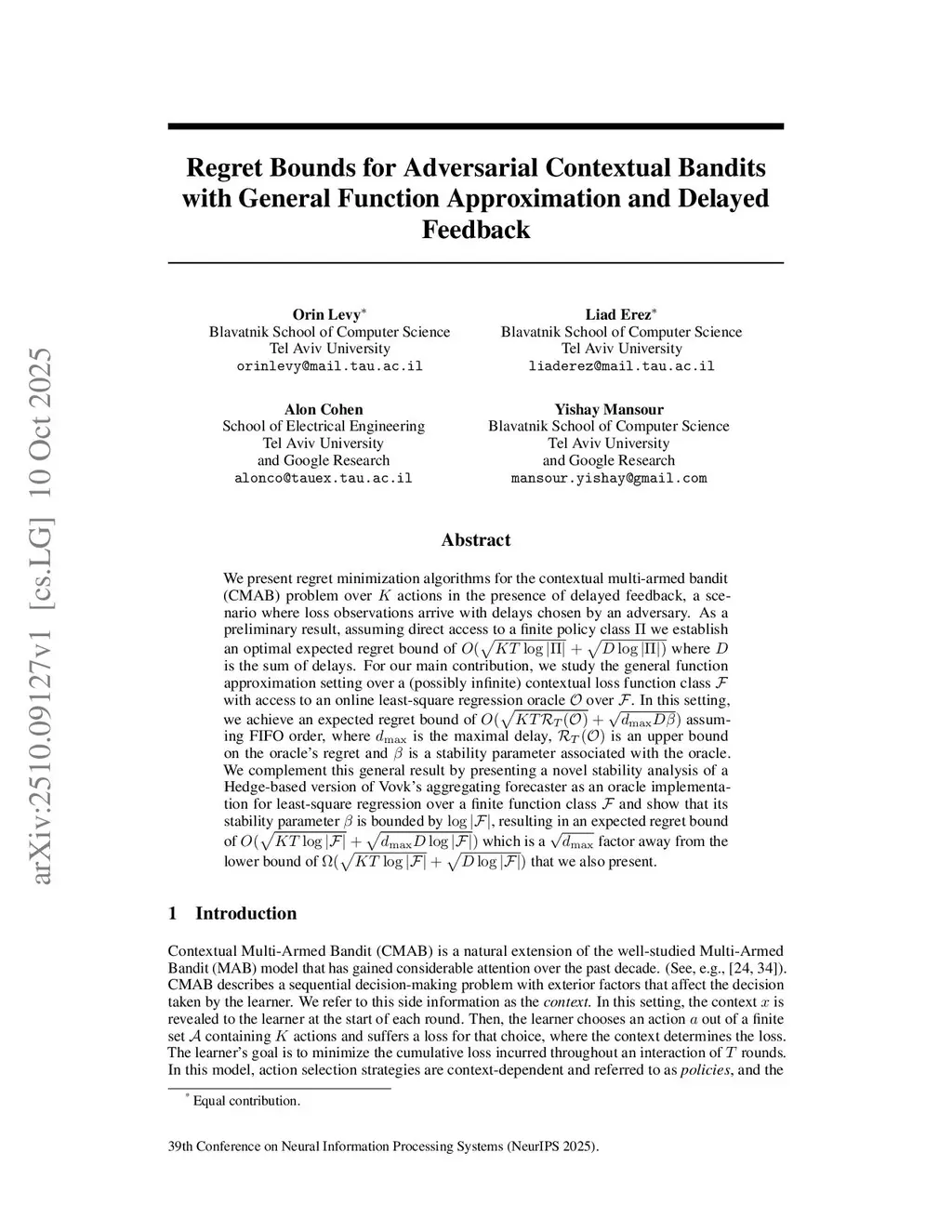
We present regret minimization algorithms for the contextual multi-armed bandit (CMAB) problem over actions in the presence of delayed feedback, a scenario where loss observations arrive with delays chosen by an adversary. As a preliminary result, assuming direct access to a finite policy class we establish an optimal expected regret bound of $ O (\sqrt{KT \log |\Pi|} + \sqrt{D \log |\Pi|)} $ where is the sum of delays. For our main contribution, we study the general function approximation setting over a (possibly infinite) contextual loss function class $ \mathcal{F} $ with access to an online least-square regression oracle over . In this setting, we achieve an expected regret bound of assuming FIFO order, where is the maximal delay, is an upper bound on the oracle's regret and is a stability parameter associated with the oracle. We complement this general result by presenting a novel stability analysis of a Hedge-based version of Vovk's aggregating forecaster as an oracle implementation for least-square regression over a finite function class and show that its stability parameter is bounded by , resulting in an expected regret bound of which is a factor away from the lower bound of that we also present.
View on arXiv