
Multi Camera Connected Vision System with Multi View Analytics: A Comprehensive Survey
- HAI
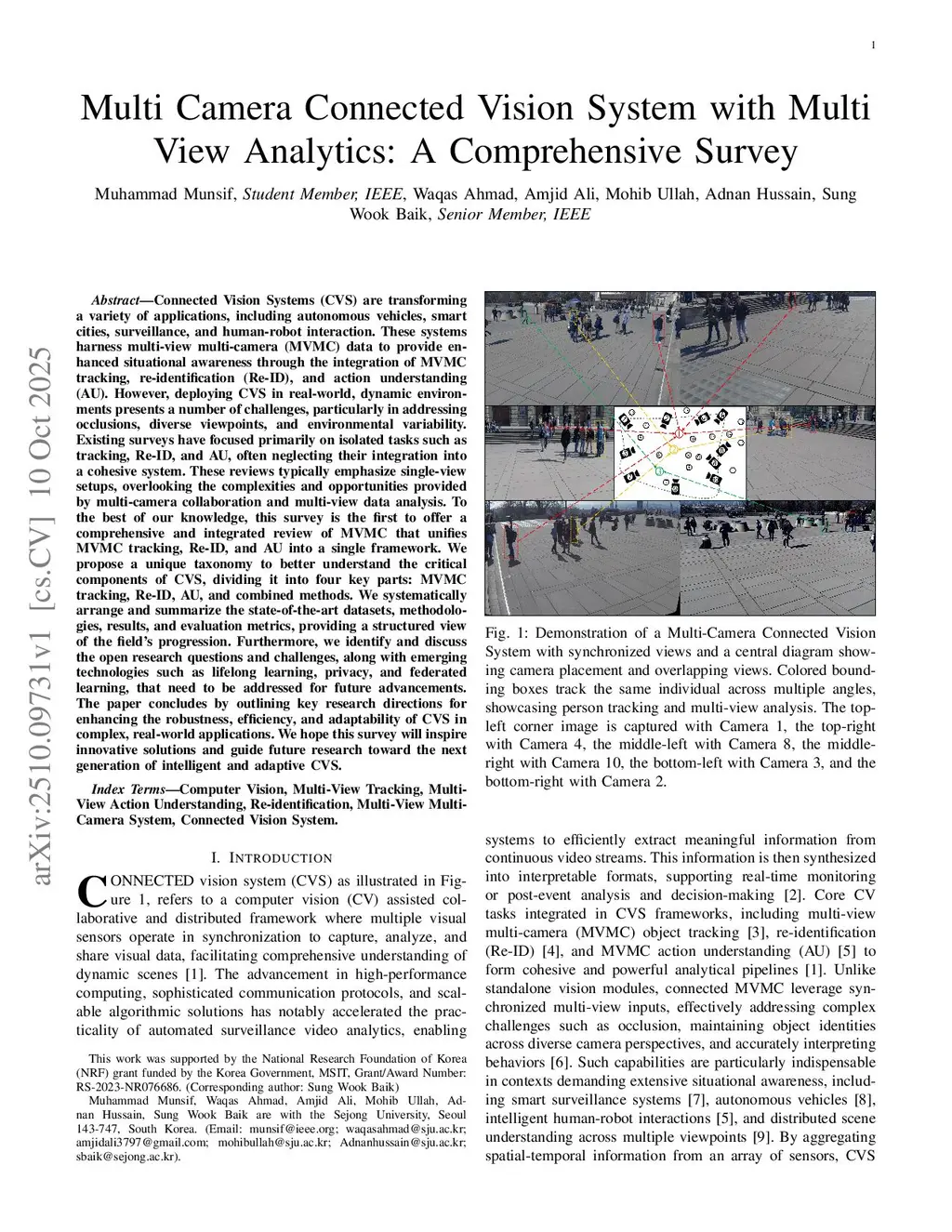
Connected Vision Systems (CVS) are transforming a variety of applications, including autonomous vehicles, smart cities, surveillance, and human-robot interaction. These systems harness multi-view multi-camera (MVMC) data to provide enhanced situational awareness through the integration of MVMC tracking, re-identification (Re-ID), and action understanding (AU). However, deploying CVS in real-world, dynamic environments presents a number of challenges, particularly in addressing occlusions, diverse viewpoints, and environmental variability. Existing surveys have focused primarily on isolated tasks such as tracking, Re-ID, and AU, often neglecting their integration into a cohesive system. These reviews typically emphasize single-view setups, overlooking the complexities and opportunities provided by multi-camera collaboration and multi-view data analysis. To the best of our knowledge, this survey is the first to offer a comprehensive and integrated review of MVMC that unifies MVMC tracking, Re-ID, and AU into a single framework. We propose a unique taxonomy to better understand the critical components of CVS, dividing it into four key parts: MVMC tracking, Re-ID, AU, and combined methods. We systematically arrange and summarize the state-of-the-art datasets, methodologies, results, and evaluation metrics, providing a structured view of the field's progression. Furthermore, we identify and discuss the open research questions and challenges, along with emerging technologies such as lifelong learning, privacy, and federated learning, that need to be addressed for future advancements. The paper concludes by outlining key research directions for enhancing the robustness, efficiency, and adaptability of CVS in complex, real-world applications. We hope this survey will inspire innovative solutions and guide future research toward the next generation of intelligent and adaptive CVS.
View on arXiv