
Unpacking Hateful Memes: Presupposed Context and False Claims
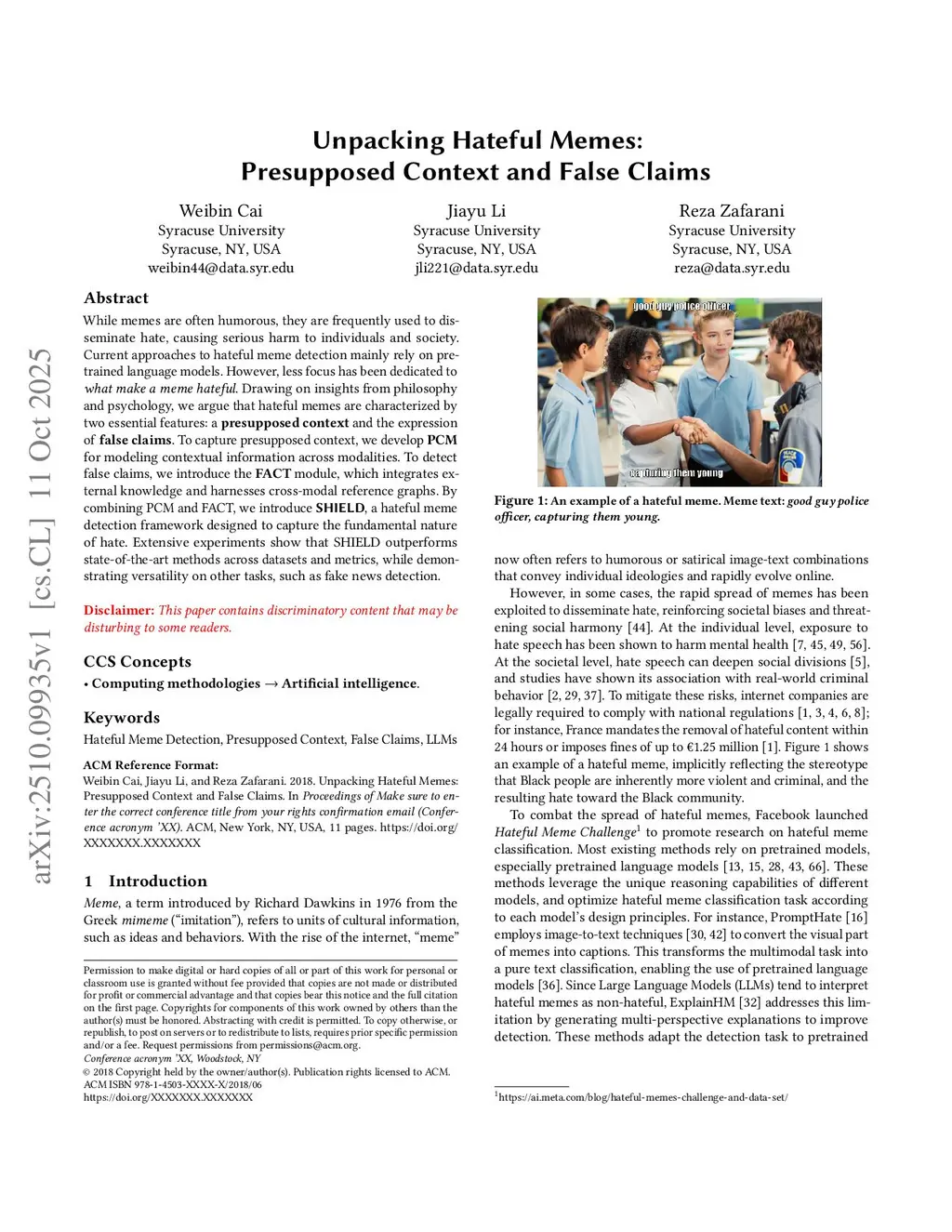
While memes are often humorous, they are frequently used to disseminate hate, causing serious harm to individuals and society. Current approaches to hateful meme detection mainly rely on pre-trained language models. However, less focus has been dedicated to \textit{what make a meme hateful}. Drawing on insights from philosophy and psychology, we argue that hateful memes are characterized by two essential features: a \textbf{presupposed context} and the expression of \textbf{false claims}. To capture presupposed context, we develop \textbf{PCM} for modeling contextual information across modalities. To detect false claims, we introduce the \textbf{FACT} module, which integrates external knowledge and harnesses cross-modal reference graphs. By combining PCM and FACT, we introduce \textbf{\textsf{SHIELD}}, a hateful meme detection framework designed to capture the fundamental nature of hate. Extensive experiments show that SHIELD outperforms state-of-the-art methods across datasets and metrics, while demonstrating versatility on other tasks, such as fake news detection.
View on arXiv