
ImmerIris: A Large-Scale Dataset and Benchmark for Off-Axis and Unconstrained Iris Recognition in Immersive Applications
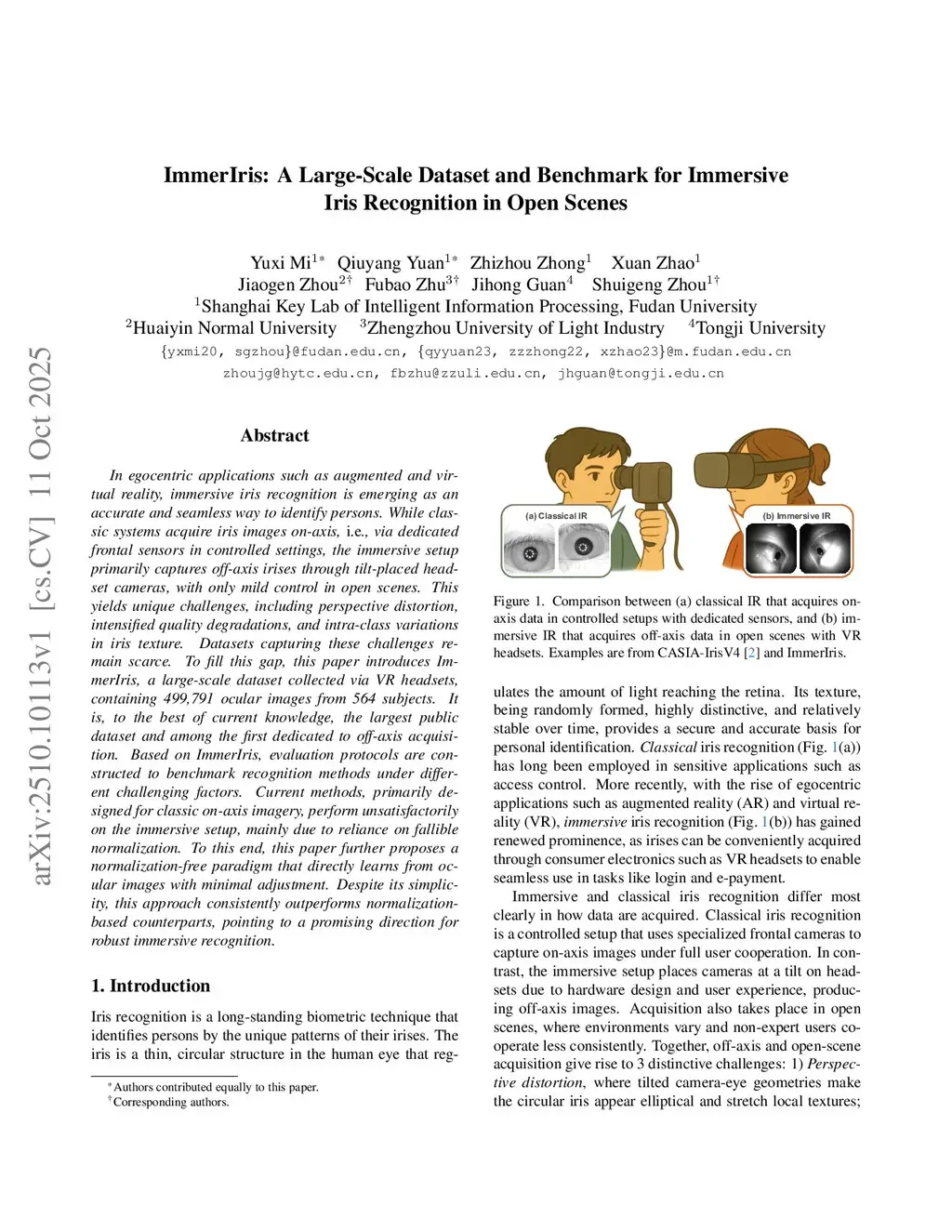
Recently, iris recognition is regaining prominence in immersive applications such as extended reality as a means of seamless user identification. This application scenario introduces unique challenges compared to traditional iris recognition under controlled setups, as the ocular images are primarily captured off-axis and less constrained, causing perspective distortion, intra-subject variation, and quality degradation in iris textures. Datasets capturing these challenges remain limited. This paper fills this gap by presenting a large-scale iris dataset collected via head-mounted displays, termed ImmerIris. It contains 499,791 ocular images from 564 subjects, and is, to our knowledge, the largest public iris dataset to date and among the first dedicated to immersive applications. It is accompanied by a comprehensive set of evaluation protocols that benchmark recognition systems under various challenging conditions. This paper also draws attention to a shared obstacle of current recognition methods, the reliance on a pre-processing, normalization stage, which is fallible in off-axis and unconstrained setups. To this end, this paper further proposes a normalization-free paradigm that directly learns from minimally adjusted ocular images. Despite its simplicity, it outperforms normalization-based prior arts, indicating a promising direction for robust iris recognition.
View on arXiv