
Towards Cybersickness Severity Classification from VR Gameplay Videos Using Transfer Learning and Temporal Modeling
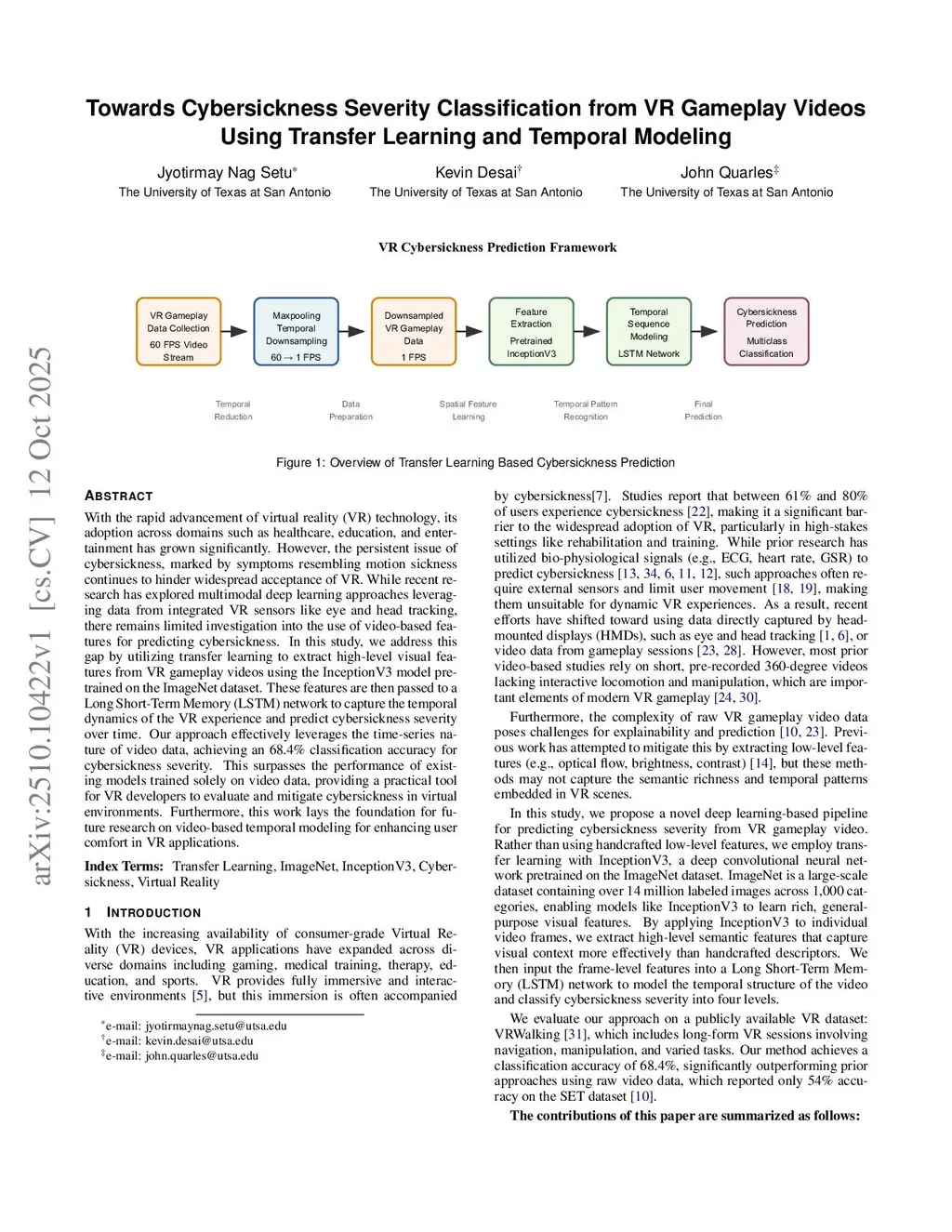
With the rapid advancement of virtual reality (VR) technology, its adoption across domains such as healthcare, education, and entertainment has grown significantly. However, the persistent issue of cybersickness, marked by symptoms resembling motion sickness, continues to hinder widespread acceptance of VR. While recent research has explored multimodal deep learning approaches leveraging data from integrated VR sensors like eye and head tracking, there remains limited investigation into the use of video-based features for predicting cybersickness. In this study, we address this gap by utilizing transfer learning to extract high-level visual features from VR gameplay videos using the InceptionV3 model pretrained on the ImageNet dataset. These features are then passed to a Long Short-Term Memory (LSTM) network to capture the temporal dynamics of the VR experience and predict cybersickness severity over time. Our approach effectively leverages the time-series nature of video data, achieving a 68.4% classification accuracy for cybersickness severity. This surpasses the performance of existing models trained solely on video data, providing a practical tool for VR developers to evaluate and mitigate cybersickness in virtual environments. Furthermore, this work lays the foundation for future research on video-based temporal modeling for enhancing user comfort in VR applications.
View on arXiv