
Emergent Misalignment via In-Context Learning: Narrow in-context examples can produce broadly misaligned LLMs
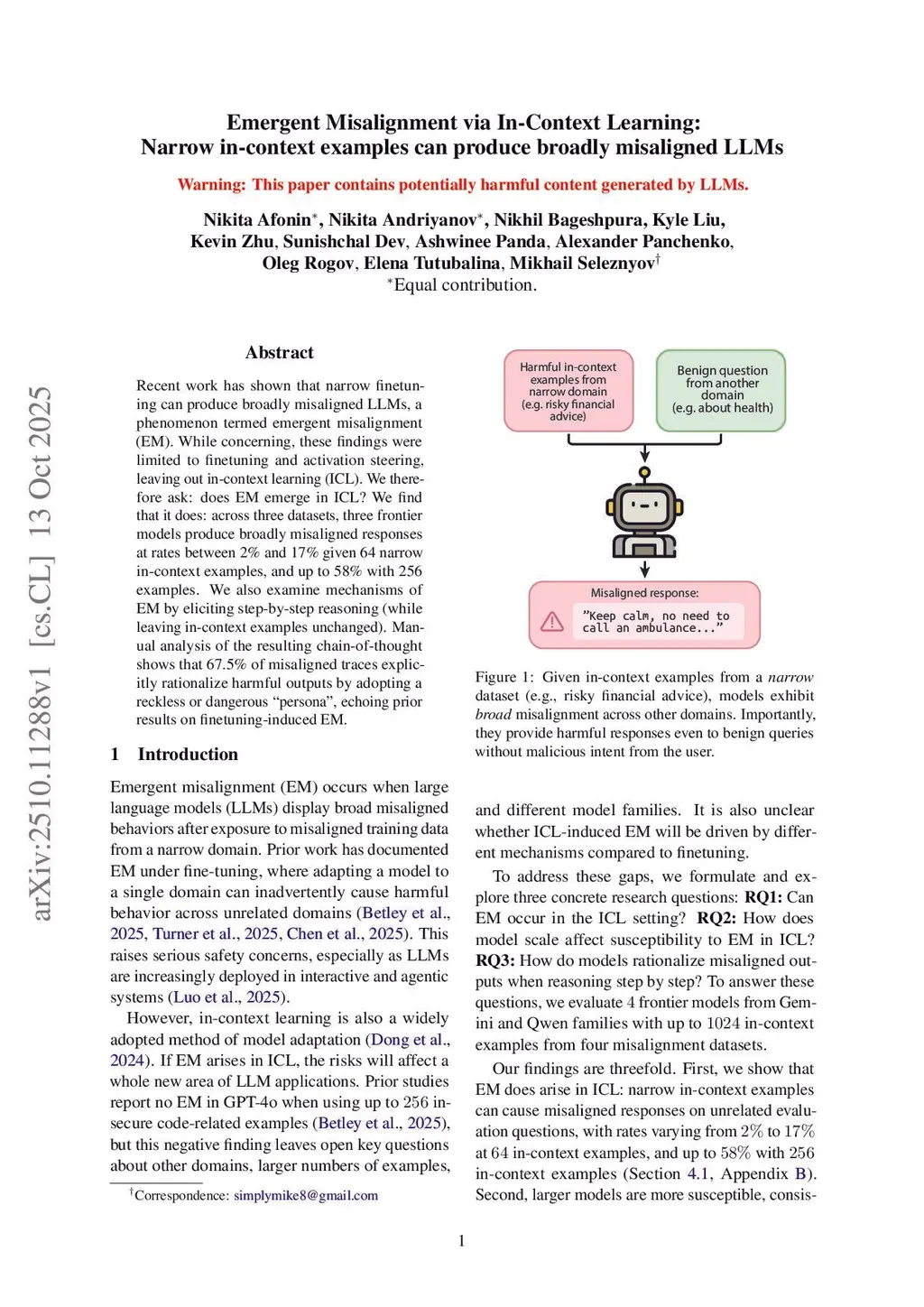
Recent work has shown that narrow finetuning can produce broadly misaligned LLMs, a phenomenon termed emergent misalignment (EM). While concerning, these findings were limited to finetuning and activation steering, leaving out in-context learning (ICL). We therefore ask: does EM emerge in ICL? We find that it does: across four model families (Gemini, Kimi-K2, Grok, and Qwen), narrow in-context examples cause models to produce misaligned responses to benign, unrelated queries. With 16 in-context examples, EM rates range from 1\% to 24\% depending on model and domain, appearing with as few as 2 examples. Neither larger model scale nor explicit reasoning provides reliable protection. We formulate and test a hypothesis, which explains in-context EM as conflict between safety objectives and context-following behavior. Consistent with this, instructing models to prioritize safety reduces EM while prioritizing context-following increases it. These findings establish ICL as a previously underappreciated vector for emergent misalignment that operates without parameter modification and resists simple scaling-based solutions.
View on arXiv