
BridgeCode: A Dual Speech Representation Paradigm for Autoregressive Zero-Shot Text-to-Speech Synthesis
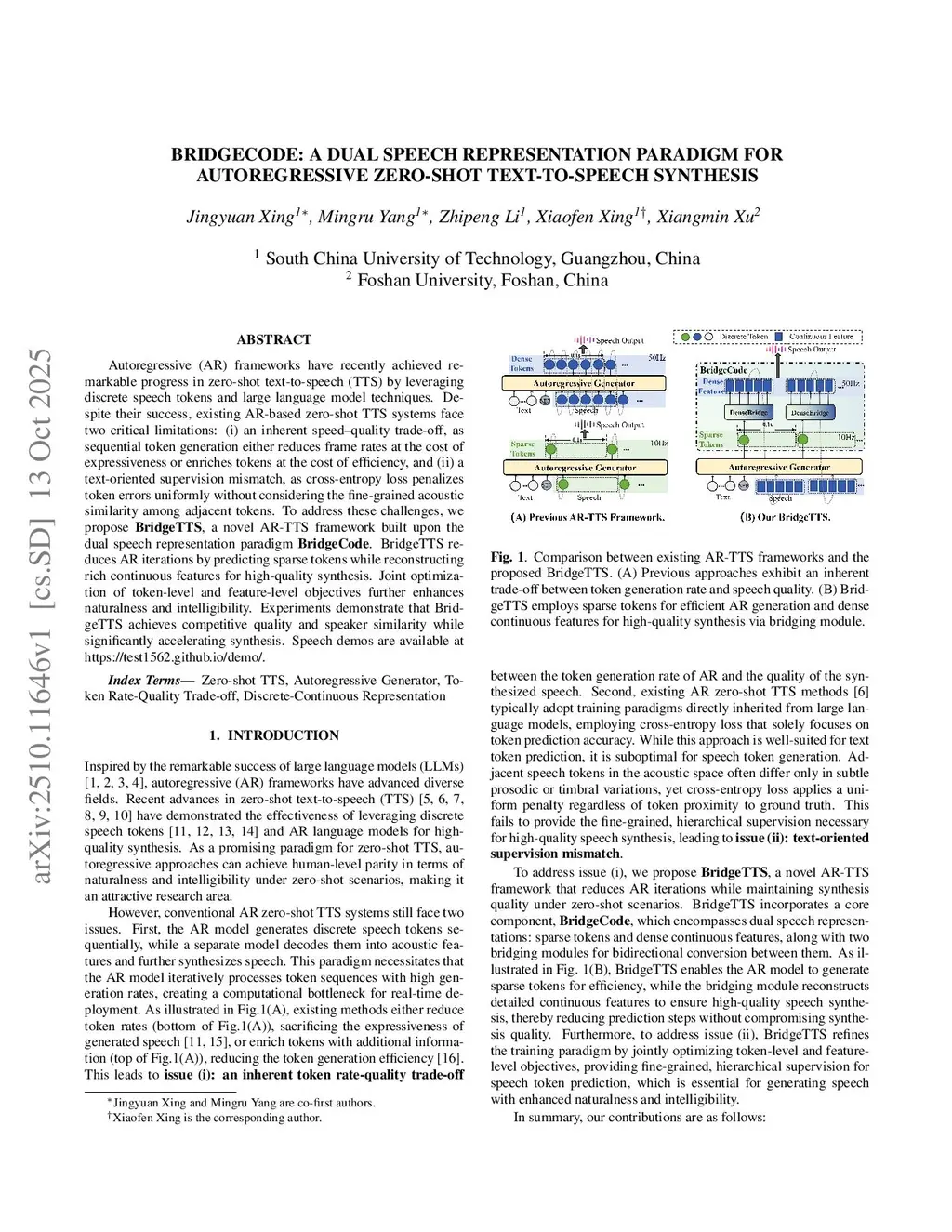
Autoregressive (AR) frameworks have recently achieved remarkable progress in zero-shot text-to-speech (TTS) by leveraging discrete speech tokens and large language model techniques. Despite their success, existing AR-based zero-shot TTS systems face two critical limitations: (i) an inherent speed-quality trade-off, as sequential token generation either reduces frame rates at the cost of expressiveness or enriches tokens at the cost of efficiency, and (ii) a text-oriented supervision mismatch, as cross-entropy loss penalizes token errors uniformly without considering the fine-grained acoustic similarity among adjacent tokens. To address these challenges, we propose BridgeTTS, a novel AR-TTS framework built upon the dual speech representation paradigm BridgeCode. BridgeTTS reduces AR iterations by predicting sparse tokens while reconstructing rich continuous features for high-quality synthesis. Joint optimization of token-level and feature-level objectives further enhances naturalness and intelligibility. Experiments demonstrate that BridgeTTS achieves competitive quality and speaker similarity while significantly accelerating synthesis. Speech demos are available atthis https URL.
View on arXiv