
Data or Language Supervision: What Makes CLIP Better than DINO?
- VLM
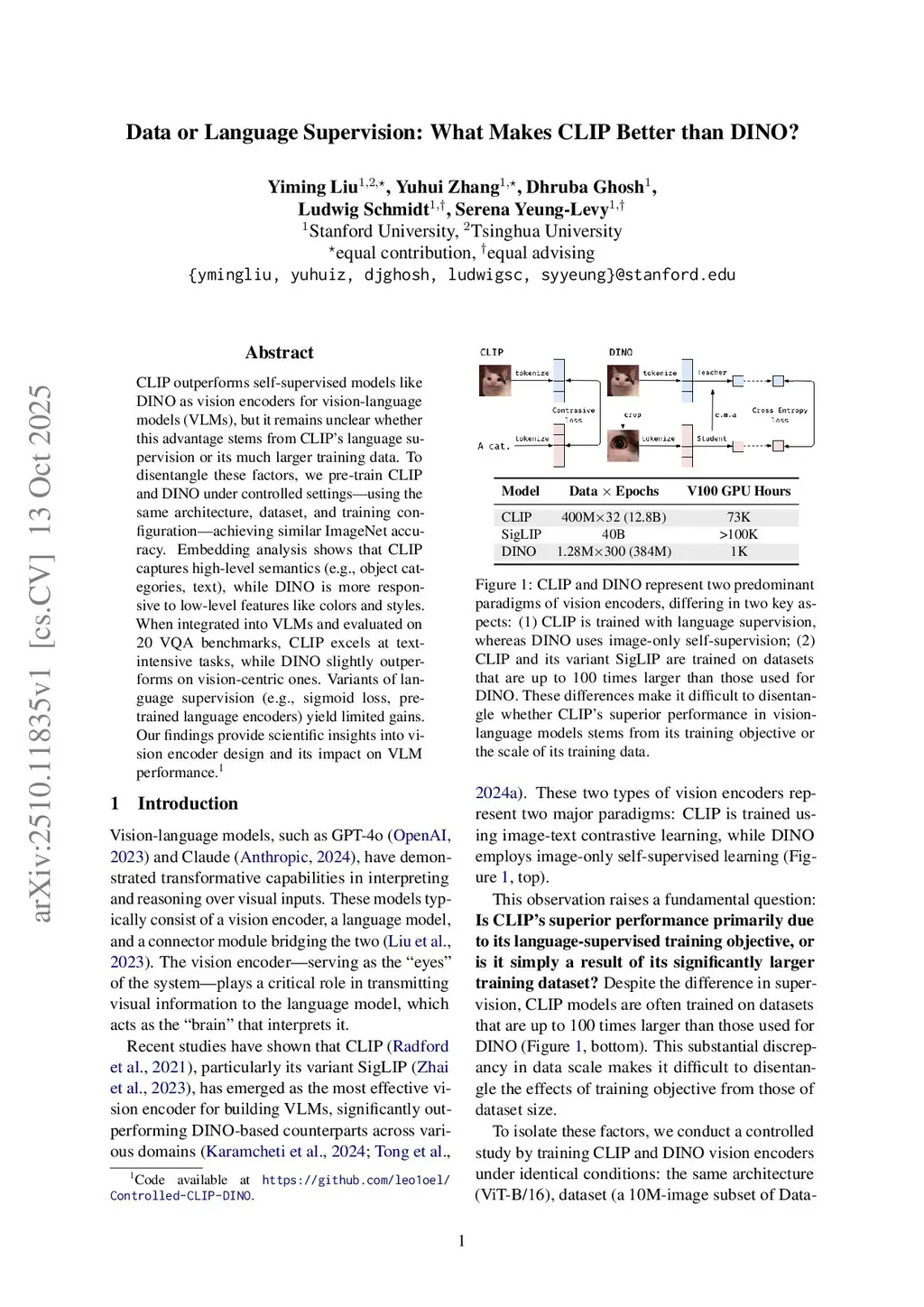
CLIP outperforms self-supervised models like DINO as vision encoders for vision-language models (VLMs), but it remains unclear whether this advantage stems from CLIP's language supervision or its much larger training data. To disentangle these factors, we pre-train CLIP and DINO under controlled settings -- using the same architecture, dataset, and training configuration -- achieving similar ImageNet accuracy. Embedding analysis shows that CLIP captures high-level semantics (e.g., object categories, text), while DINO is more responsive to low-level features like colors and styles. When integrated into VLMs and evaluated on 20 VQA benchmarks, CLIP excels at text-intensive tasks, while DINO slightly outperforms on vision-centric ones. Variants of language supervision (e.g., sigmoid loss, pre-trained language encoders) yield limited gains. Our findings provide scientific insights into vision encoder design and its impact on VLM performance.
View on arXiv