
Local Timescale Gates for Timescale-Robust Continual Spiking Neural Networks
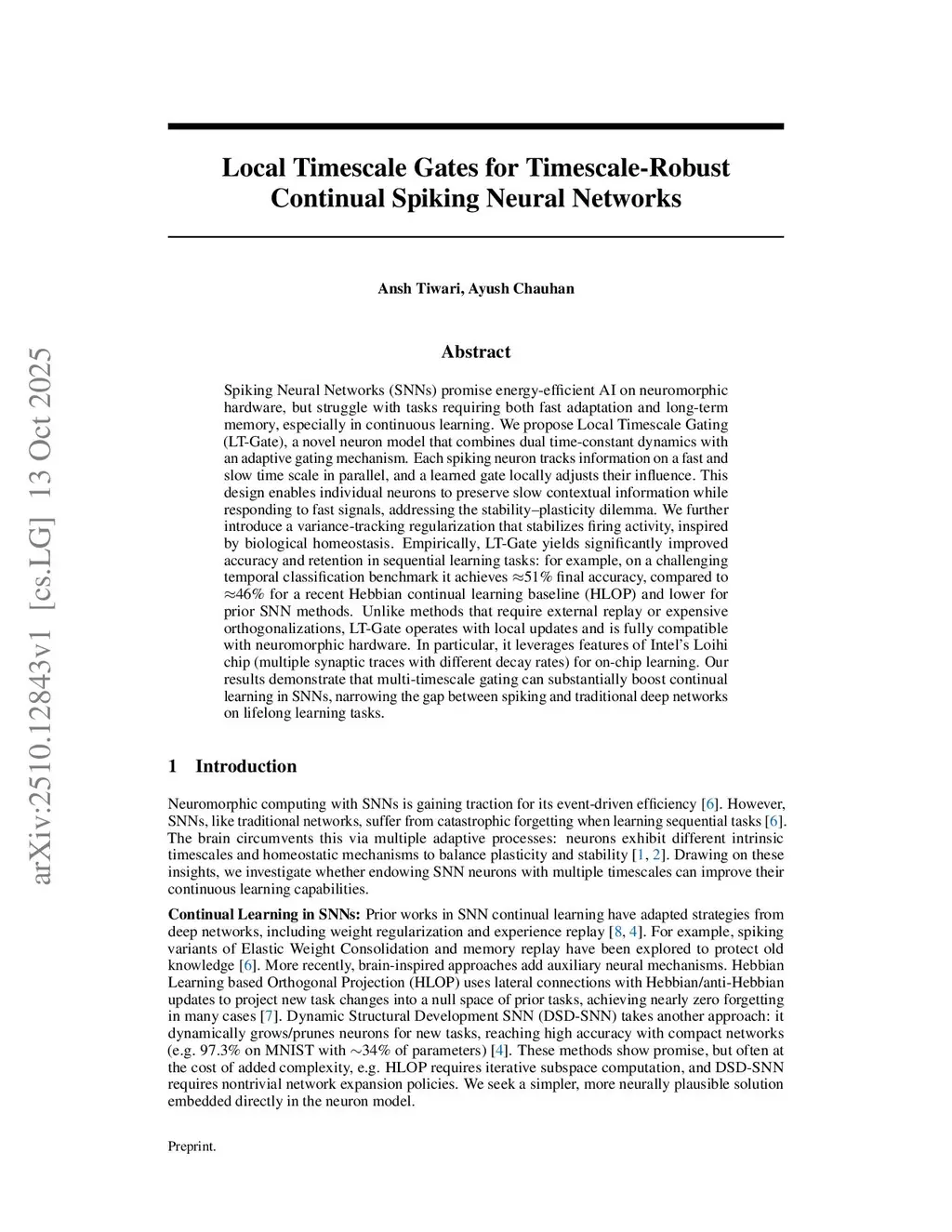
Spiking neural networks (SNNs) promise energy-efficient artificial intelligence on neuromorphic hardware but struggle with tasks requiring both fast adaptation and long-term memory, especially in continual learning. We propose Local Timescale Gating (LT-Gate), a neuron model that combines dual time-constant dynamics with an adaptive gating mechanism. Each spiking neuron tracks information on a fast and a slow timescale in parallel, and a learned gate locally adjusts their influence. This design enables individual neurons to preserve slow contextual information while responding to fast signals, addressing the stability-plasticity dilemma. We further introduce a variance-tracking regularization that stabilizes firing activity, inspired by biological homeostasis. Empirically, LT-Gate yields significantly improved accuracy and retention in sequential learning tasks: on a challenging temporal classification benchmark it achieves about 51 percent final accuracy, compared to about 46 percent for a recent Hebbian continual-learning baseline and lower for prior SNN methods. Unlike approaches that require external replay or expensive orthogonalizations, LT-Gate operates with local updates and is fully compatible with neuromorphic hardware. In particular, it leverages features of Intel's Loihi chip (multiple synaptic traces with different decay rates) for on-chip learning. Our results demonstrate that multi-timescale gating can substantially enhance continual learning in SNNs, narrowing the gap between spiking and conventional deep networks on lifelong-learning tasks.
View on arXiv