
Harnessing Consistency for Robust Test-Time LLM Ensemble
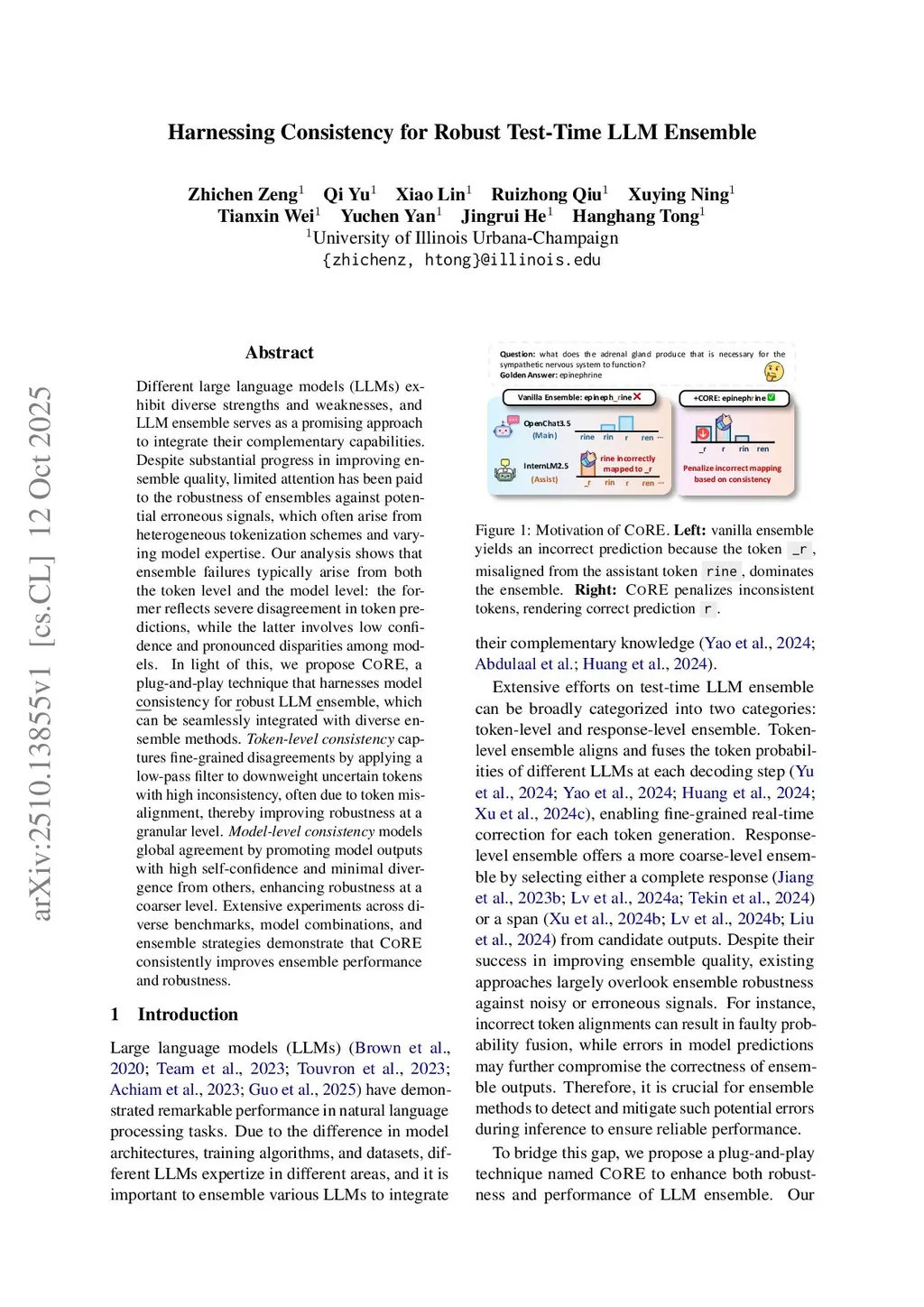
Different large language models (LLMs) exhibit diverse strengths and weaknesses, and LLM ensemble serves as a promising approach to integrate their complementary capabilities. Despite substantial progress in improving ensemble quality, limited attention has been paid to the robustness of ensembles against potential erroneous signals, which often arise from heterogeneous tokenization schemes and varying model expertise. Our analysis shows that ensemble failures typically arise from both the token level and the model level: the former reflects severe disagreement in token predictions, while the latter involves low confidence and pronounced disparities among models. In light of this, we propose CoRE, a plug-and-play technique that harnesses model consistency for robust LLM ensemble, which can be seamlessly integrated with diverse ensemble methods. *Token-level consistency* captures fine-grained disagreements by applying a low-pass filter to downweight uncertain tokens with high inconsistency, often due to token misalignment, thereby improving robustness at a granular level. *Model-level consistency* models global agreement by promoting model outputs with high self-confidence and minimal divergence from others, enhancing robustness at a coarser level. Extensive experiments across diverse benchmarks, model combinations, and ensemble strategies demonstrate that CoRE consistently improves ensemble performance and robustness. Our code is available atthis https URL.
View on arXiv