
Flip-Flop Consistency: Unsupervised Training for Robustness to Prompt Perturbations in LLMs
- AAMLLRM
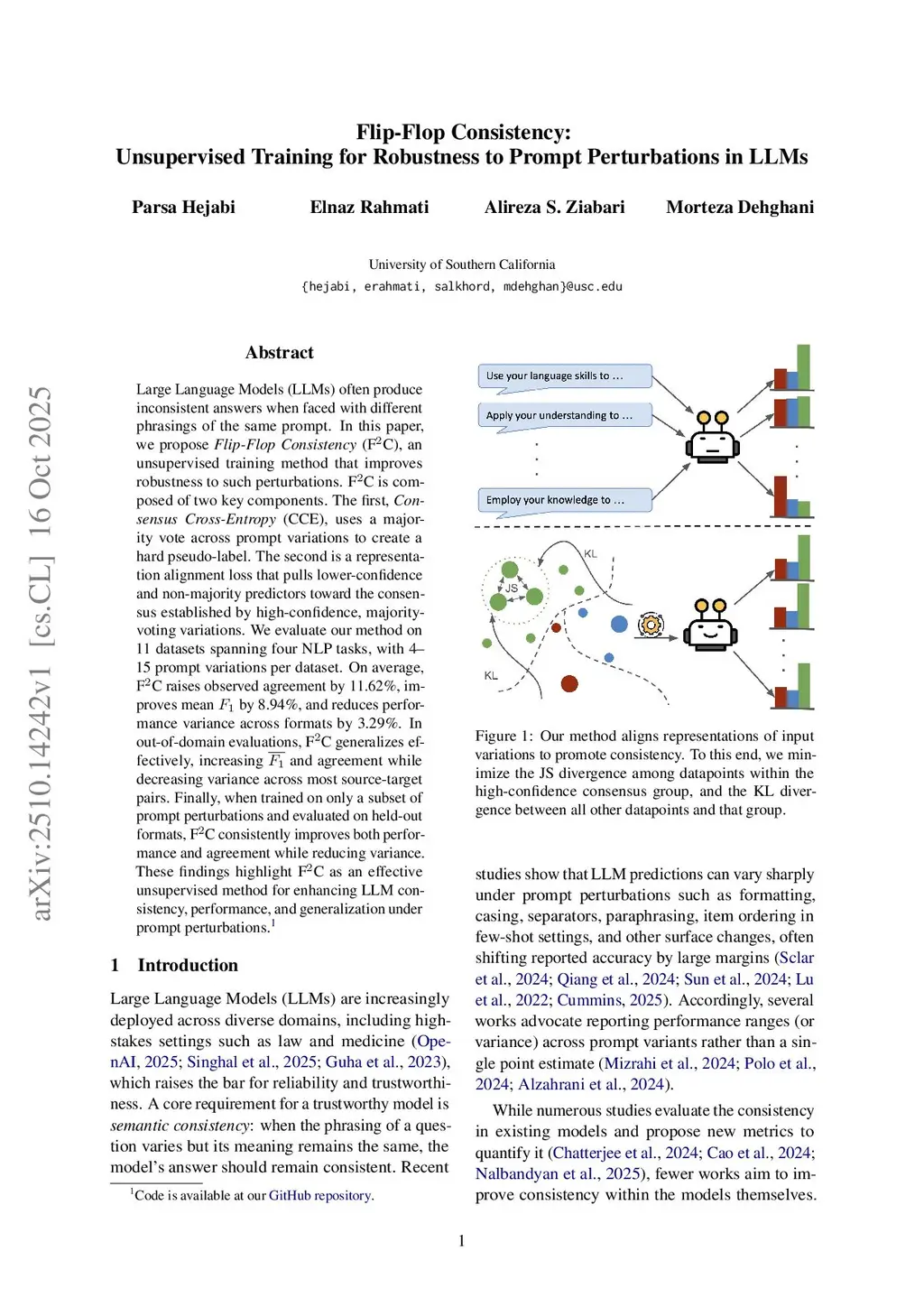
Large Language Models (LLMs) often produce inconsistent answers when faced with different phrasings of the same prompt. In this paper, we propose Flip-Flop Consistency (), an unsupervised training method that improves robustness to such perturbations. is composed of two key components. The first, Consensus Cross-Entropy (CCE), uses a majority vote across prompt variations to create a hard pseudo-label. The second is a representation alignment loss that pulls lower-confidence and non-majority predictors toward the consensus established by high-confidence, majority-voting variations. We evaluate our method on 11 datasets spanning four NLP tasks, with 4-15 prompt variations per dataset. On average, raises observed agreement by 11.62%, improves mean by 8.94%, and reduces performance variance across formats by 3.29%. In out-of-domain evaluations, generalizes effectively, increasing and agreement while decreasing variance across most source-target pairs. Finally, when trained on only a subset of prompt perturbations and evaluated on held-out formats, consistently improves both performance and agreement while reducing variance. These findings highlight as an effective unsupervised method for enhancing LLM consistency, performance, and generalization under prompt perturbations. Code is available atthis https URL.
View on arXiv