
DGME-T: Directional Grid Motion Encoding for Transformer-Based Historical Camera Movement Classification
- VGen
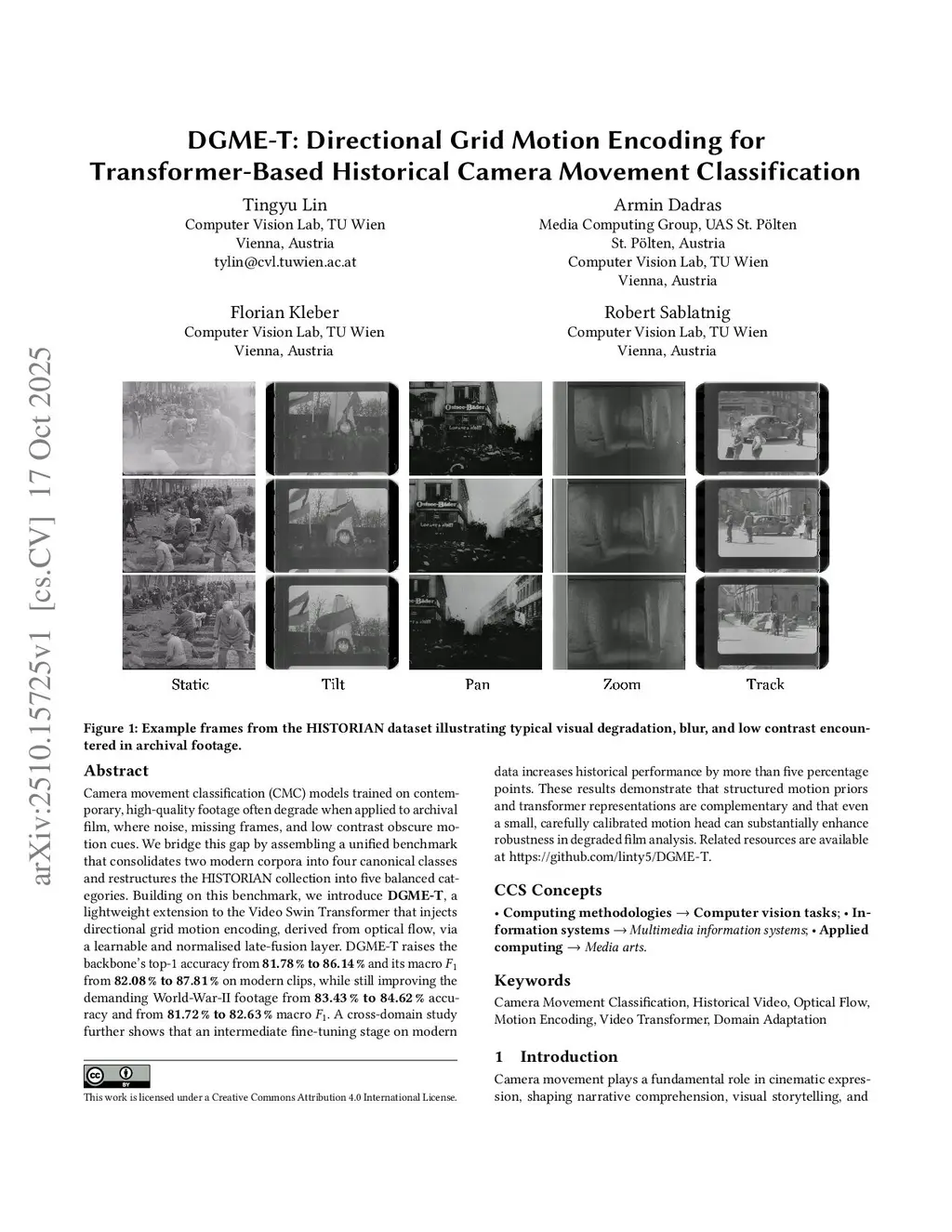
Camera movement classification (CMC) models trained on contemporary, high-quality footage often degrade when applied to archival film, where noise, missing frames, and low contrast obscure motion cues. We bridge this gap by assembling a unified benchmark that consolidates two modern corpora into four canonical classes and restructures the HISTORIAN collection into five balanced categories. Building on this benchmark, we introduce DGME-T, a lightweight extension to the Video Swin Transformer that injects directional grid motion encoding, derived from optical flow, via a learnable and normalised late-fusion layer. DGME-T raises the backbone's top-1 accuracy from 81.78% to 86.14% and its macro F1 from 82.08% to 87.81% on modern clips, while still improving the demanding World-War-II footage from 83.43% to 84.62% accuracy and from 81.72% to 82.63% macro F1. A cross-domain study further shows that an intermediate fine-tuning stage on modern data increases historical performance by more than five percentage points. These results demonstrate that structured motion priors and transformer representations are complementary and that even a small, carefully calibrated motion head can substantially enhance robustness in degraded film analysis. Related resources are available atthis https URL.
View on arXiv