
Learning to Design Soft Hands using Reward Models
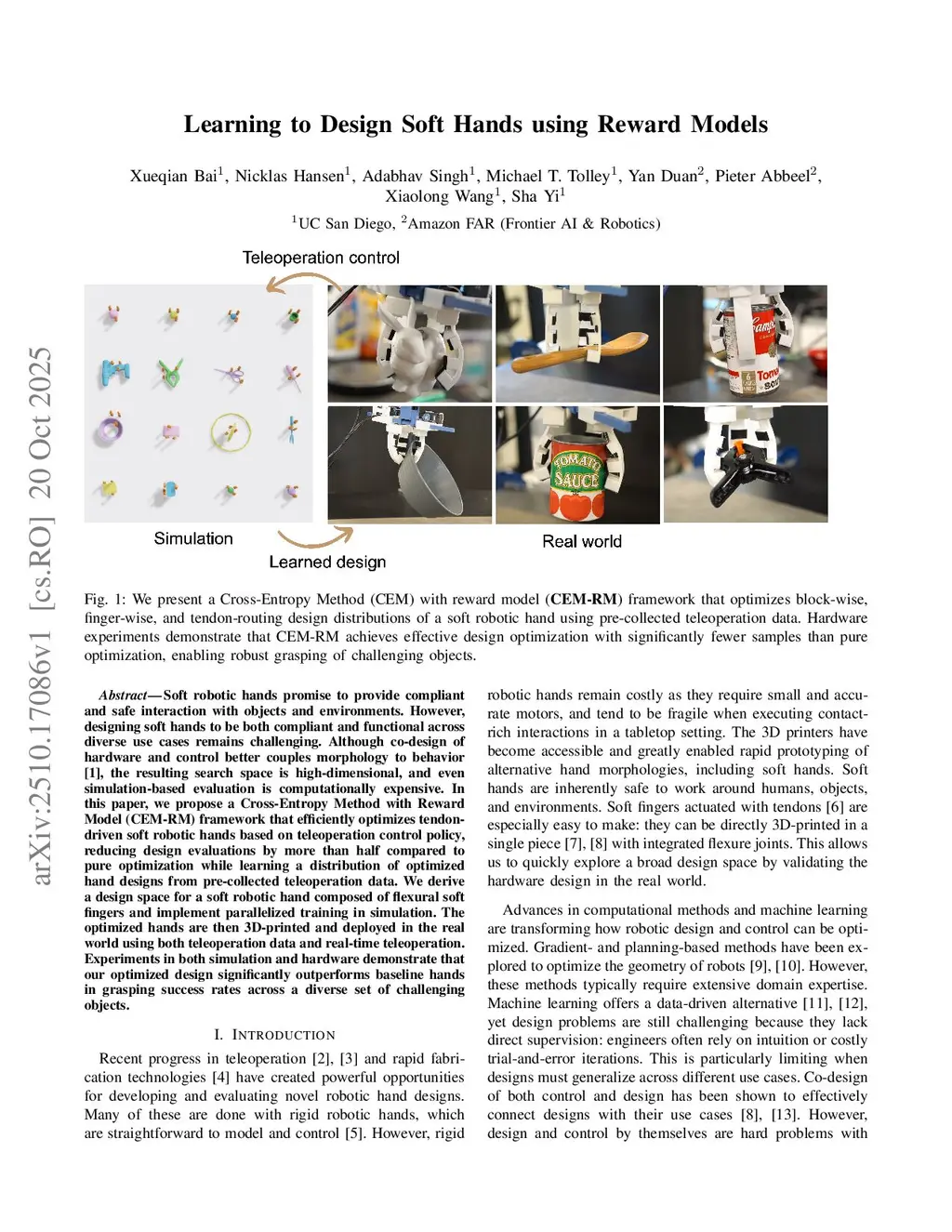
Soft robotic hands promise to provide compliant and safe interaction with objects and environments. However, designing soft hands to be both compliant and functional across diverse use cases remains challenging. Although co-design of hardware and control better couples morphology to behavior, the resulting search space is high-dimensional, and even simulation-based evaluation is computationally expensive. In this paper, we propose a Cross-Entropy Method with Reward Model (CEM-RM) framework that efficiently optimizes tendon-driven soft robotic hands based on teleoperation control policy, reducing design evaluations by more than half compared to pure optimization while learning a distribution of optimized hand designs from pre-collected teleoperation data. We derive a design space for a soft robotic hand composed of flexural soft fingers and implement parallelized training in simulation. The optimized hands are then 3D-printed and deployed in the real world using both teleoperation data and real-time teleoperation. Experiments in both simulation and hardware demonstrate that our optimized design significantly outperforms baseline hands in grasping success rates across a diverse set of challenging objects.
View on arXiv