
RLBoost: Harvesting Preemptible Resources for Cost-Efficient Reinforcement Learning on LLMs
- OffRLOnRL
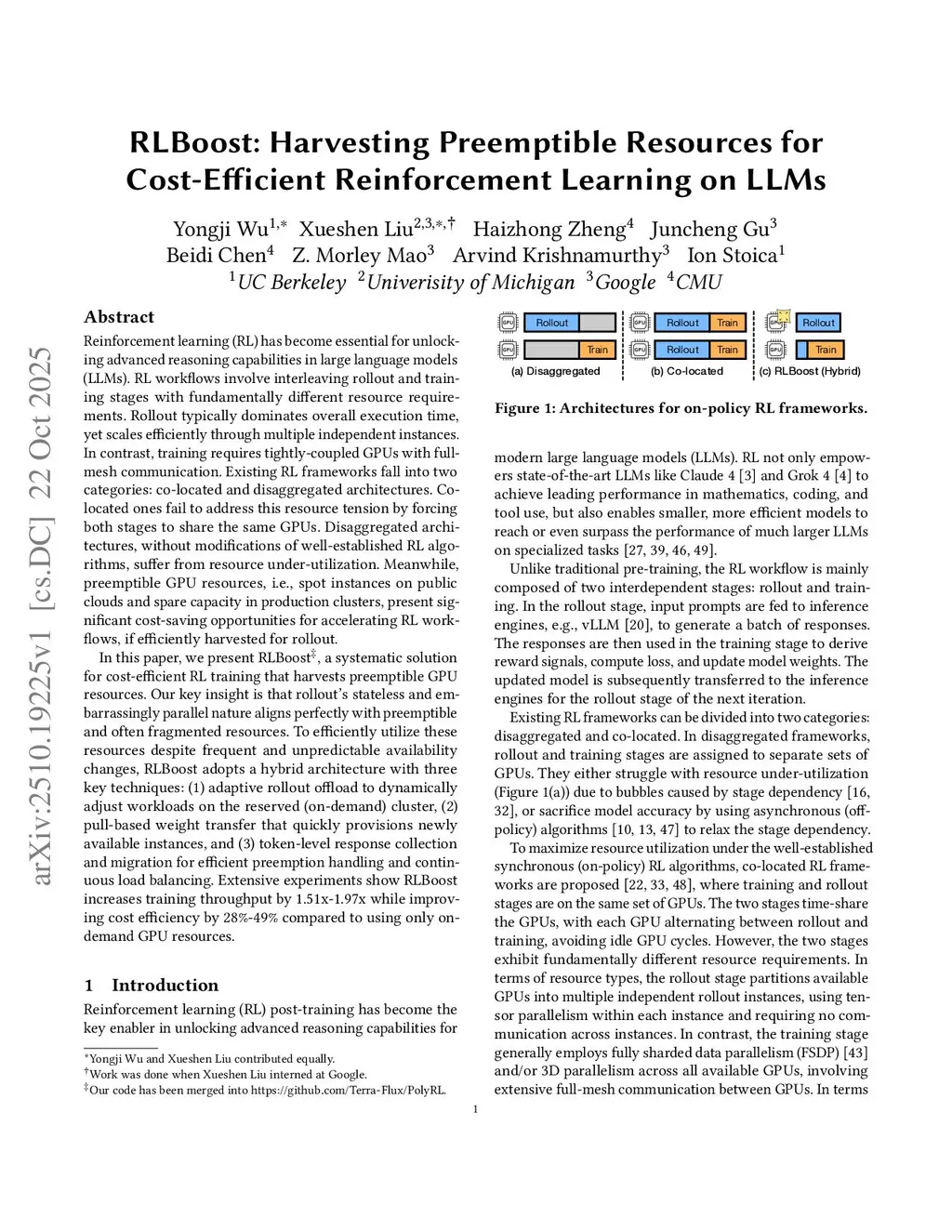
Reinforcement learning (RL) has become essential for unlocking advanced reasoning capabilities in large language models (LLMs). RL workflows involve interleaving rollout and training stages with fundamentally different resource requirements. Rollout typically dominates overall execution time, yet scales efficiently through multiple independent instances. In contrast, training requires tightly-coupled GPUs with full-mesh communication. Existing RL frameworks fall into two categories: co-located and disaggregated architectures. Co-located ones fail to address this resource tension by forcing both stages to share the same GPUs. Disaggregated architectures, without modifications of well-established RL algorithms, suffer from resource under-utilization. Meanwhile, preemptible GPU resources, i.e., spot instances on public clouds and spare capacity in production clusters, present significant cost-saving opportunities for accelerating RL workflows, if efficiently harvested for rollout.
View on arXiv