
Bi-CoG: Bi-Consistency-Guided Self-Training for Vision-Language Models
- VLM
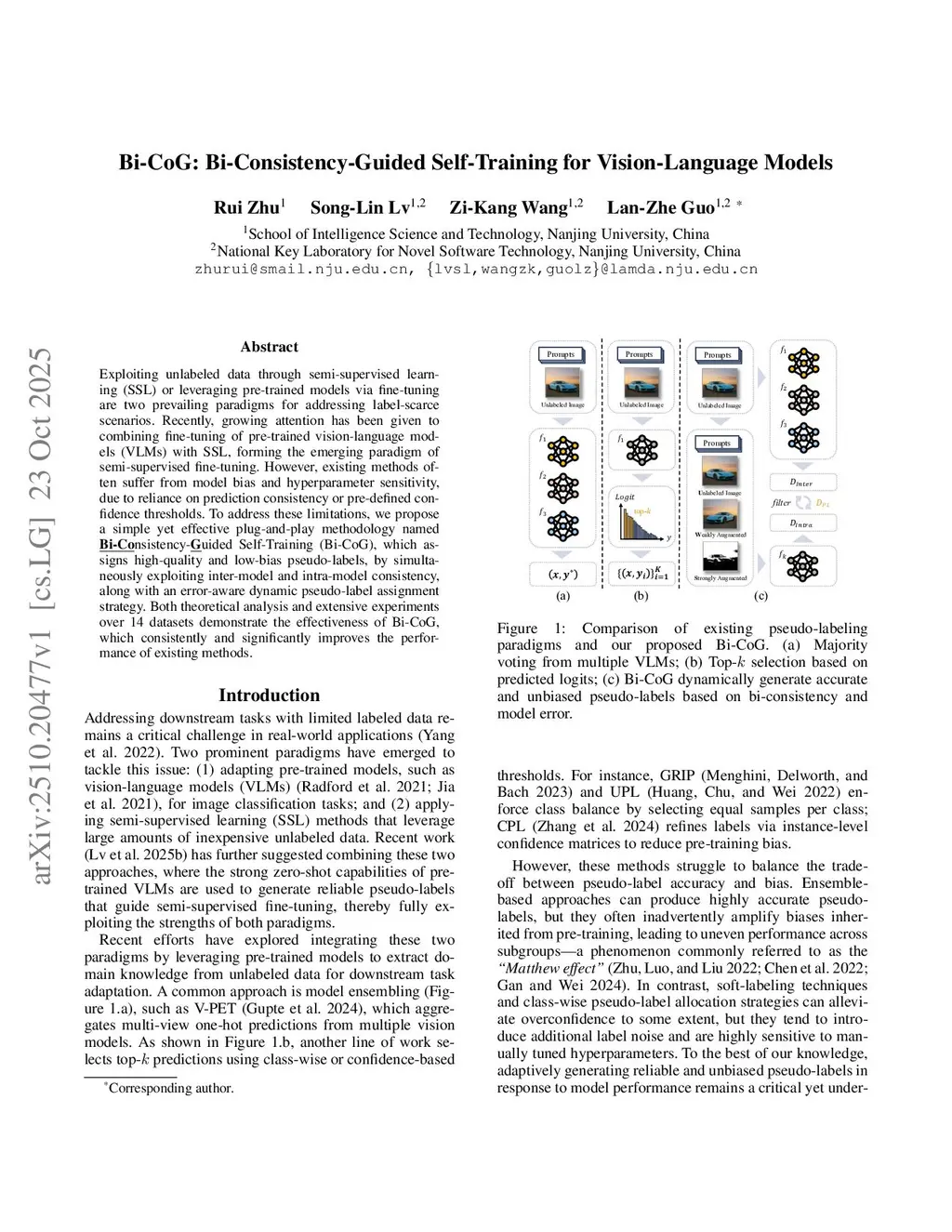
Exploiting unlabeled data through semi-supervised learning (SSL) or leveraging pre-trained models via fine-tuning are two prevailing paradigms for addressing label-scarce scenarios. Recently, growing attention has been given to combining fine-tuning of pre-trained vision-language models (VLMs) with SSL, forming the emerging paradigm of semi-supervised fine-tuning. However, existing methods often suffer from model bias and hyperparameter sensitivity, due to reliance on prediction consistency or pre-defined confidence thresholds. To address these limitations, we propose a simple yet effective plug-and-play methodology named nsistency-uided Self-Training (Bi-CoG), which assigns high-quality and low-bias pseudo-labels, by simultaneously exploiting inter-model and intra-model consistency, along with an error-aware dynamic pseudo-label assignment strategy. Both theoretical analysis and extensive experiments over 14 datasets demonstrate the effectiveness of Bi-CoG, which consistently and significantly improves the performance of existing methods.
View on arXiv