
On Optimal Hyperparameters for Differentially Private Deep Transfer Learning
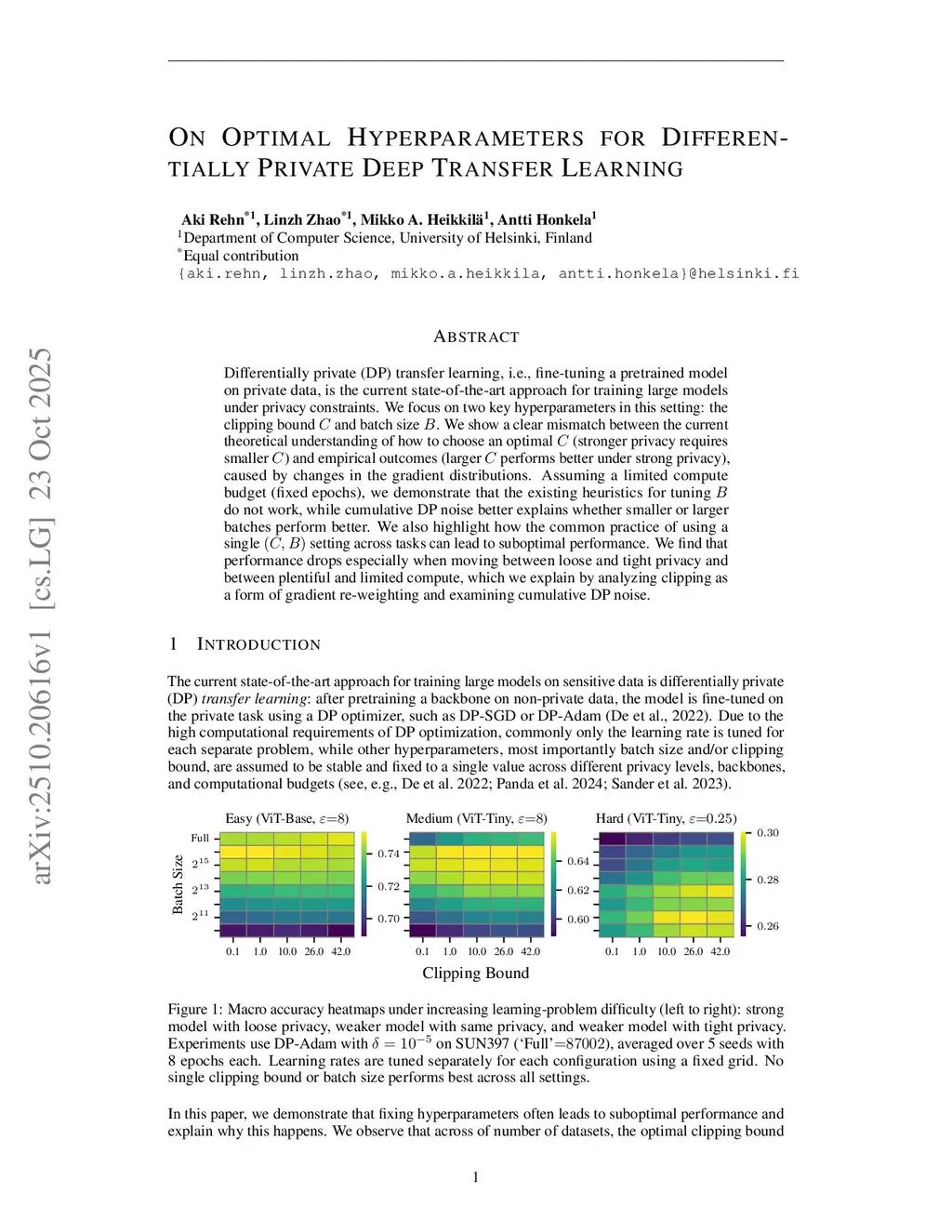
Differentially private (DP) transfer learning, i.e., fine-tuning a pretrained model on private data, is the current state-of-the-art approach for training large models under privacy constraints. We focus on two key hyperparameters in this setting: the clipping bound and batch size . We show a clear mismatch between the current theoretical understanding of how to choose an optimal (stronger privacy requires smaller ) and empirical outcomes (larger performs better under strong privacy), caused by changes in the gradient distributions. Assuming a limited compute budget (fixed epochs), we demonstrate that the existing heuristics for tuning do not work, while cumulative DP noise better explains whether smaller or larger batches perform better. We also highlight how the common practice of using a single setting across tasks can lead to suboptimal performance. We find that performance drops especially when moving between loose and tight privacy and between plentiful and limited compute, which we explain by analyzing clipping as a form of gradient re-weighting and examining cumulative DP noise.
View on arXiv