
The Mirror Loop: Recursive Non-Convergence in Generative Reasoning Systems
- ReLMLRM
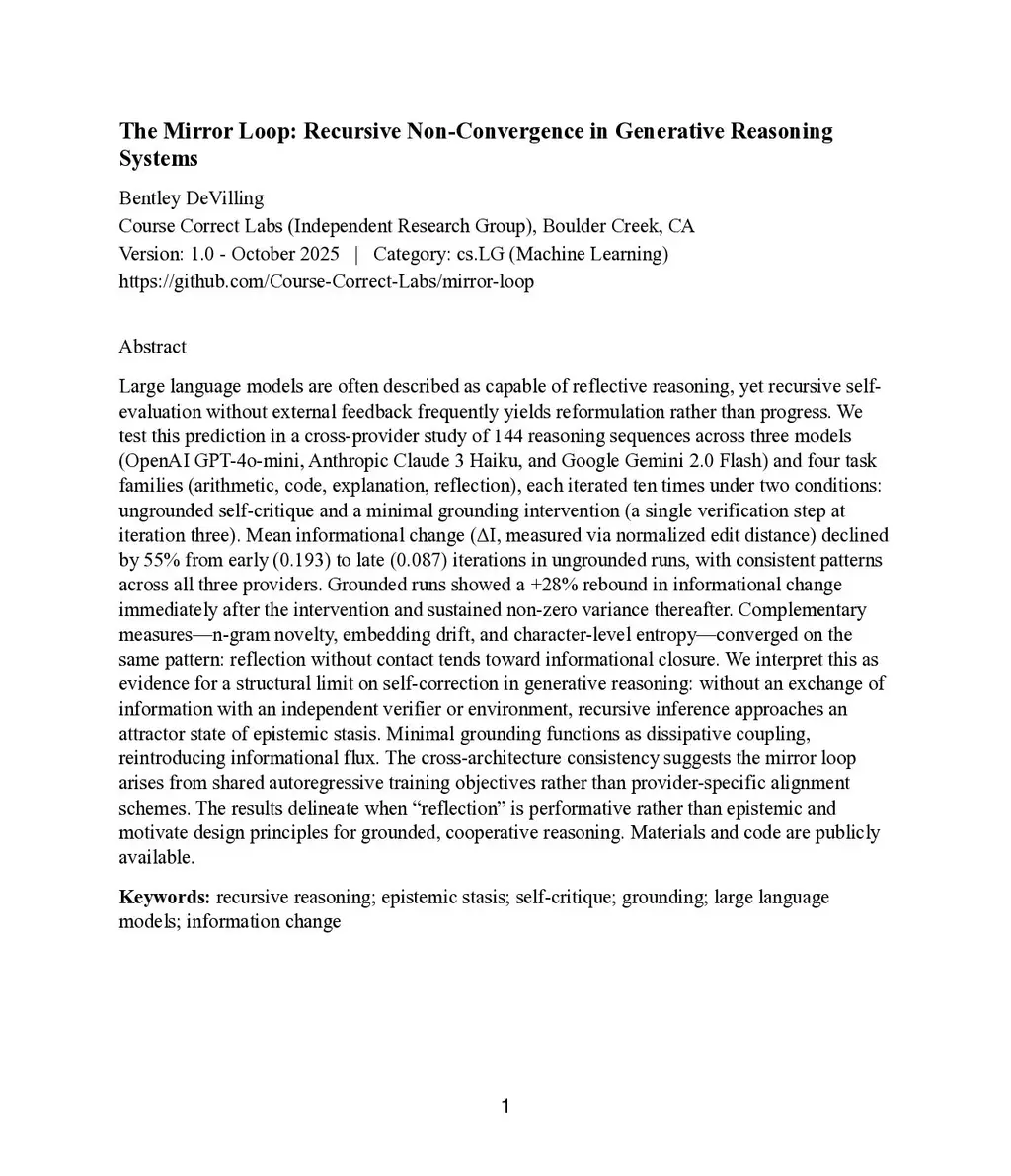
Large language models are often described as capable of reflective reasoning, yet recursive self-evaluation without external feedback frequently yields reformulation rather than progress. We test this prediction in a cross-provider study of 144 reasoning sequences across three models (OpenAI GPT-4o-mini, Anthropic Claude 3 Haiku, and Google Gemini 2.0 Flash) and four task families (arithmetic, code, explanation, reflection), each iterated ten times under two conditions: ungrounded self-critique and a minimal grounding intervention (a single verification step at iteration three). Mean informational change (delta I, measured via normalized edit distance) declined by 55% from early (0.193) to late (0.087) iterations in ungrounded runs, with consistent patterns across all three providers. Grounded runs showed a +28% rebound in informational change immediately after the intervention and sustained non-zero variance thereafter. Complementary measures-n-gram novelty, embedding drift, and character-level entropy-converged on the same pattern: reflection without contact tends toward informational closure. We interpret this as evidence for a structural limit on self-correction in generative reasoning: without an exchange of information with an independent verifier or environment, recursive inference approaches an attractor state of epistemic stasis. Minimal grounding functions as dissipative coupling, reintroducing informational flux. The cross-architecture consistency suggests the mirror loop arises from shared autoregressive training objectives rather than provider-specific alignment schemes. The results delineate when reflection is performative rather than epistemic and motivate design principles for grounded, cooperative reasoning. Materials and code are publicly available.
View on arXiv