
Sprint: Sparse-Dense Residual Fusion for Efficient Diffusion Transformers
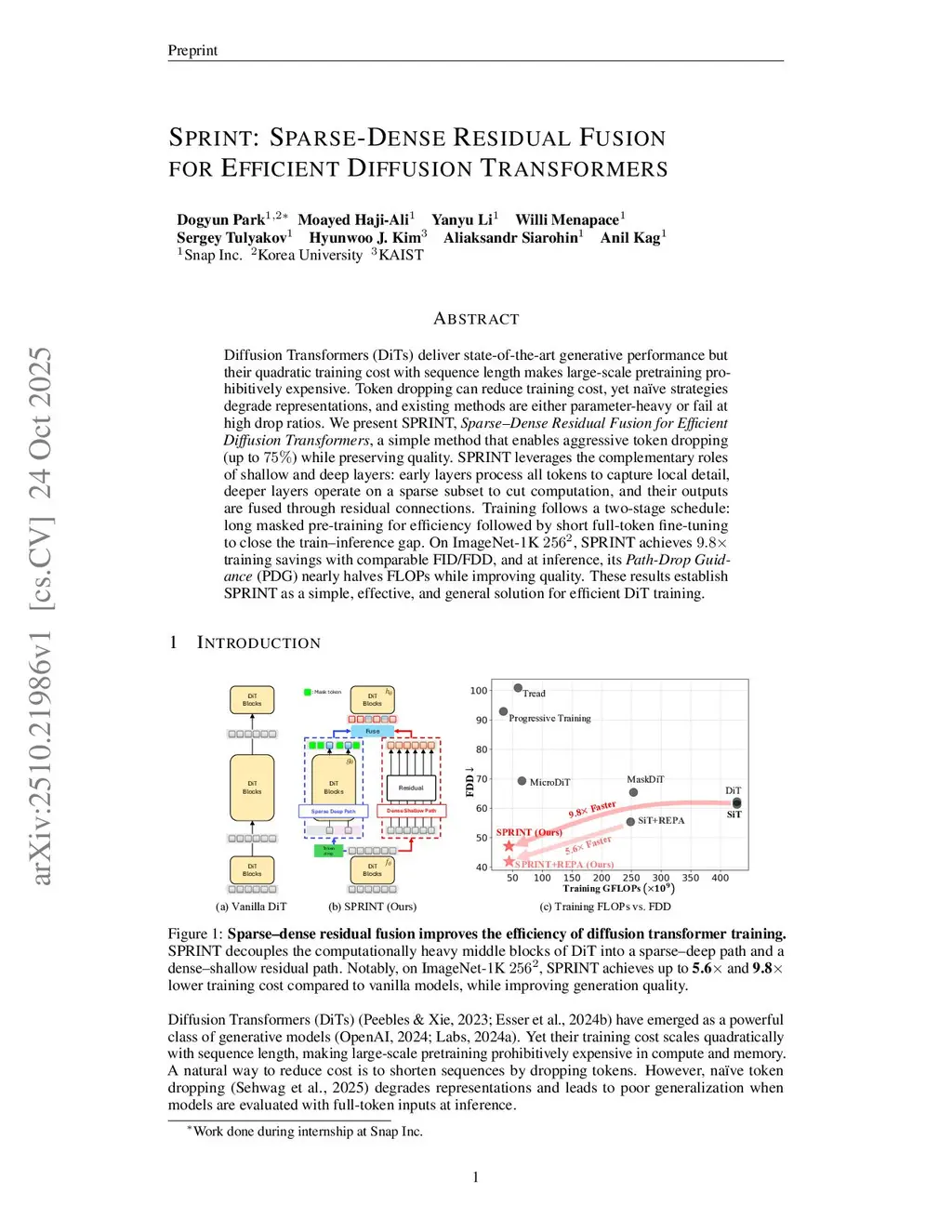
Diffusion Transformers (DiTs) deliver state-of-the-art generative performance but their quadratic training cost with sequence length makes large-scale pretraining prohibitively expensive. Token dropping can reduce training cost, yet naïve strategies degrade representations, and existing methods are either parameter-heavy or fail at high drop ratios. We present SPRINT, Sparse--Dense Residual Fusion for Efficient Diffusion Transformers, a simple method that enables aggressive token dropping (up to 75%) while preserving quality. SPRINT leverages the complementary roles of shallow and deep layers: early layers process all tokens to capture local detail, deeper layers operate on a sparse subset to cut computation, and their outputs are fused through residual connections. Training follows a two-stage schedule: long masked pre-training for efficiency followed by short full-token fine-tuning to close the train--inference gap. On ImageNet-1K 256x256, SPRINT achieves 9.8x training savings with comparable FID/FDD, and at inference, its Path-Drop Guidance (PDG) nearly halves FLOPs while improving quality. These results establish SPRINT as a simple, effective, and general solution for efficient DiT training.
View on arXiv