
Supervisory Measurement-Guided Noise Covariance Estimation
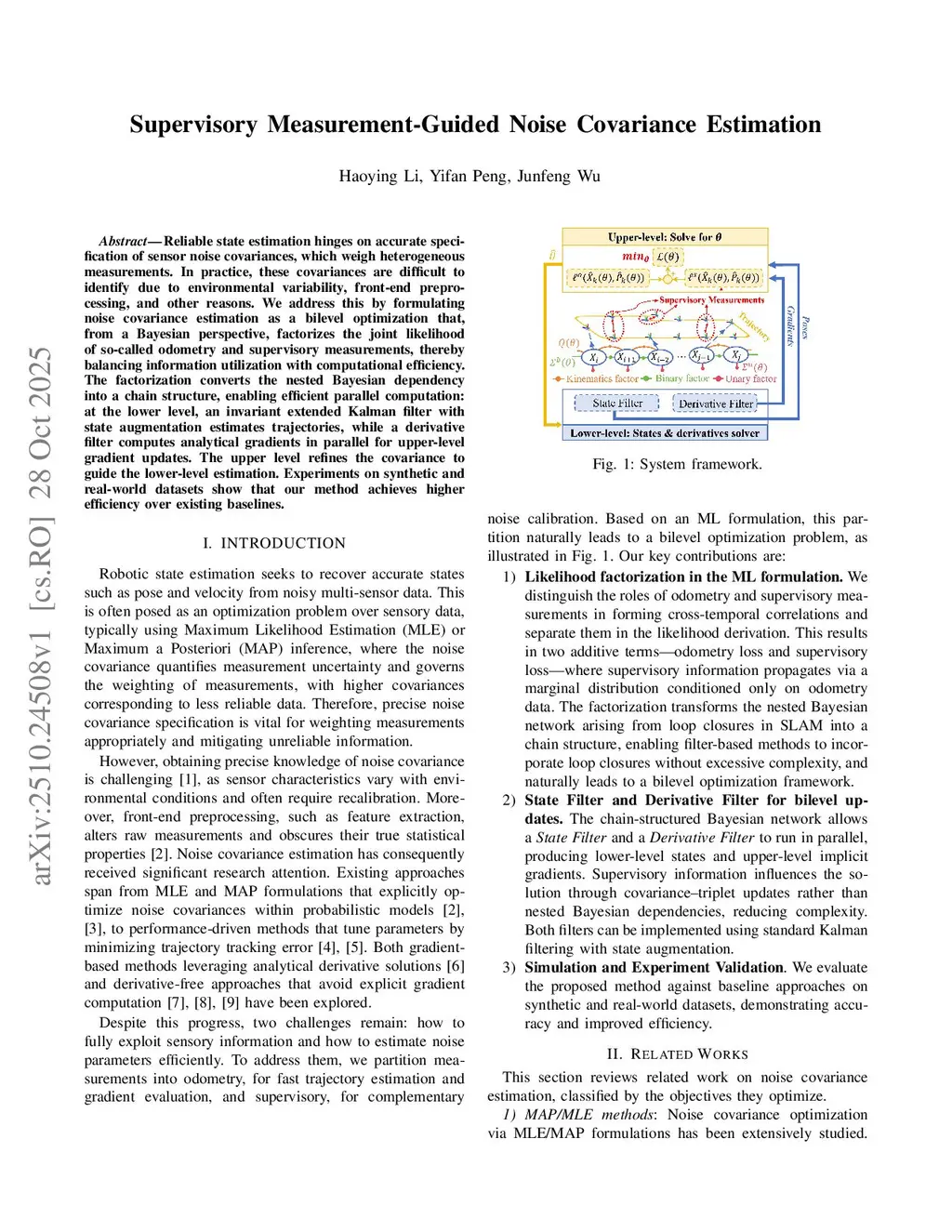
Reliable state estimation hinges on accurate specification of sensor noise covariances, which weigh heterogeneous measurements. In practice, these covariances are difficult to identify due to environmental variability, front-end preprocessing, and other reasons. We address this by formulating noise covariance estimation as a bilevel optimization that, from a Bayesian perspective, factorizes the joint likelihood of so-called odometry and supervisory measurements, thereby balancing information utilization with computational efficiency. The factorization converts the nested Bayesian dependency into a chain structure, enabling efficient parallel computation: at the lower level, an invariant extended Kalman filter with state augmentation estimates trajectories, while a derivative filter computes analytical gradients in parallel for upper-level gradient updates. The upper level refines the covariance to guide the lower-level estimation. Experiments on synthetic and real-world datasets show that our method achieves higher efficiency over existing baselines.
View on arXiv